Best Cordless Tire Inflator for Cars, Bikes and Balls
In this guide
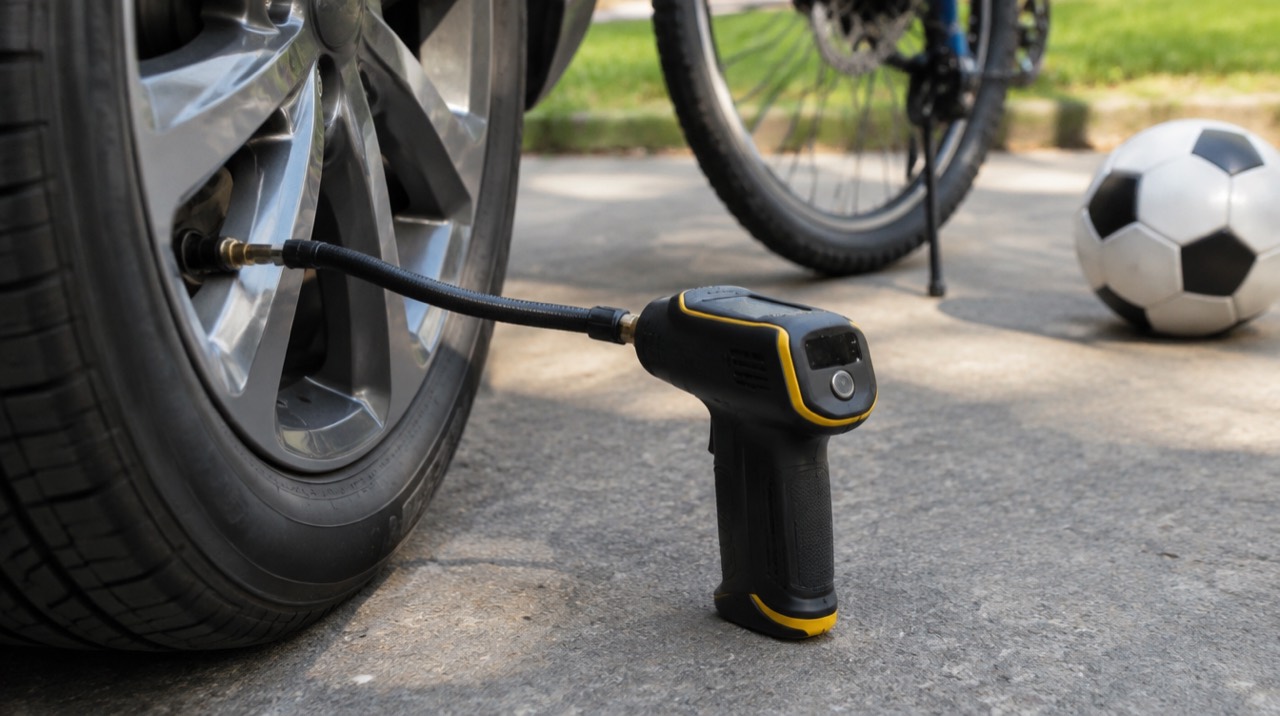
The best cordless tire inflator for most drivers is a compact battery unit that tops up a car tire in about a minute, does several tires per charge, and shuts off at a preset pressure; if you want insurance against a flat battery, choose a dual-power model with a 12V cord. Cordless inflators are top-off tools for cars, bikes and balls, not compressors for truck or RV tires, and the better makers say so on the box. This is a spec-based roundup: every pick is compared on the maker’s published figures, read from the current Amazon listings on 2026-10-28, not on tests we ran.
Disclosure: As an Amazon Associate I earn from qualifying purchases. WOLFBOX, Birtokom, Eyshwu, Smartour and Musotica, featured below, pay a bonus commission through Amazon Creator Connections. See /disclosure/.
What actually separates cordless inflators
Nearly every cordless inflator now has a digital gauge, presets for car, bike, motorcycle and ball, and auto shut-off. The differences that matter are:
- Fill speed. Most makers quote the time to top up a 195/65R15 tire by 5 to 8 PSI, which is a fair like-for-like test of the motor. Some also give airflow in liters per minute.
- Tires per charge. Driven by battery size. A 1 lb palm unit may do a handful of top-ups; a larger one, two dozen.
- Backup power. A dual-power unit with a 12V cord never strands you with a flat battery.
- Tire size limit. Small units stop being useful on big SUV and LT tires, which hold far more air.
- Duty cycle. How long it can run before it needs to cool down.
Peak PSI is the least important number. Passenger tires typically run 30 to 40 PSI; 150 PSI matters mostly for road bikes.
Spec comparison
| Inflator | Max PSI | Car top-up (maker) | Battery | Tires per charge (maker) | 12V backup | Notes |
|---|---|---|---|---|---|---|
| WOLFBOX MegaFlow24-NEW | 150 | 29→36 PSI in 60 s | 3 x 4,000 mAh | up to 24 sedan | Yes, 11 ft | not for pickups/large SUVs |
| WOLFBOX HyperFlow19 | 150 | 30→35 PSI in 1 min | 2 x 2,600 mAh | up to 9 | No | 1 lb, plug kit |
| Birtokom T06 | 150 | 28→36 PSI under 1 min | 6,000 mAh | up to 4 flats | No | metal cylinder, 35 L/min |
| Birtokom T05-E | 150 | 30→35 PSI in 60 s | 6,000 mAh | up to 12 (30→35) | No | 15+ min continuous |
| Eyshwu dual power | 150 | 0→36 PSI in about 6 min | 5,400 mAh | 4+ (from flat) | Yes | nozzle storage |
| Smartour | not stated | 20-30 s per 1 PSI | not stated | not stated | No | bikes and balls |
| Musotica 2-in-1 (DeWalt 20V) | 150 | 0→36 PSI in 3 min | your 20V battery | depends on battery | Yes | jump clamps; 10 on/10 off |
| Fanttik X8 APEX | 150 | 28→33 PSI in 56 s (215/55R17) | not in listing | 17 without pause | No | up to 26.3 in tires |
| AstroAI L7 | 150 | 30→36 PSI in 1.5 min | 4,000 mAh | up to 8 | No | under 1 lb |
Per the Amazon listings, checked 2026-10-28. Fill times are the makers’ own figures under their own conditions. Check the current price on Amazon.
Note that “from 0” and “top-up” figures are not comparable: refilling a flat tire from 0 PSI takes many times longer than adding 6 PSI.
The picks
Best all-round for cars and crossovers: WOLFBOX MegaFlow24-NEW
Smallest and lightest: WOLFBOX HyperFlow19 or AstroAI L7
The AstroAI L7 is the comparable non-featured option: under 1 lb, 4,000 mAh, up to 8 top-ups per charge, with a listed 10-minute rest after 15 minutes of running and a stated limit of tires up to 25 inches.
Most tires per charge without a cord: Birtokom T05-E
Faster pump for back-to-back tires: Birtokom T06
Dual power on a budget battery: Eyshwu
For bikes and balls: Smartour
If you own DeWalt 20V batteries: Musotica 2-in-1 or DEWALT DCC020IB
DEWALT’s own DCC020IB runs on the same batteries, adds 110V AC power and a high-volume mode for air mattresses, and carries DEWALT’s 3-year limited warranty per its product page. It has no jump function.
When cordless is the wrong tool
Cordless inflators are sized for passenger tires. For a half-ton pickup on LT tires at 50 to 80 PSI, a cordless unit can top up a few PSI but will run hot and slow on a refill. Look at a 12V direct-to-battery compressor with a published L/min figure instead; tire inflator for truck tires covers flow rate and duty cycle. If you want one box for a dead battery and a soft tire, jump starter with air compressor weighs the combo units.
Using one correctly
- Set pressure from the door-jamb placard, not the tire sidewall. NHTSA guidance is explicit that the number molded on the sidewall is not the pressure to inflate to; see how to check tire pressure.
- Check cold. Pressure rises as the tire warms; measure before driving or after the car has sat for a few hours.
- Set the preset a touch high only if your manual says to. Some gauges read while the pump runs; let it settle and recheck.
- Respect the duty cycle. If the unit gets hot or the listing gives an on/off cycle, rest it.
- Verify with a separate gauge. ±1 PSI claims are maker claims. A quality pencil or digital gauge is cheap insurance; tire inflator accuracy explains why readings differ.
Low pressure is a safety issue, not just a fuel-economy one. Federal rules under FMVSS 138 require a tire-pressure warning when a tire falls 25 percent below the placard pressure, which is already well past where you should have topped it up.
Bottom line
- Most cars and crossovers, with backup power: WOLFBOX MegaFlow24-NEW.
- Smallest for a glove box: WOLFBOX HyperFlow19 or AstroAI L7.
- Most top-ups per charge without a cord: Birtokom T05-E.
- Several tires in one session: Birtokom T06.
- Dual power on a smaller battery: Eyshwu.
- Bikes and balls: Smartour.
- DeWalt 20V owners: Musotica 2-in-1 (adds jump clamps) or DEWALT DCC020IB.
Check the current price on Amazon and the maker’s tire-size limit before you buy.
Frequently asked questions
What is the best cordless tire inflator for a car?
For a sedan or small crossover, a pack-sized inflator that lists a one-minute top-up of a 195/65R15 tire and several tires per charge covers most needs, such as the WOLFBOX MegaFlow24-NEW, Birtokom T05-E or Fanttik X8 APEX. If you also want a backup cord for unlimited runtime, pick a dual-power model with a 12V lead.
Can a cordless tire inflator fill a truck tire?
It can top one up, but it is the wrong tool for large tires. Several makers say so in their listings: WOLFBOX's MegaFlow24-NEW says it is not suitable for pickups or large SUVs, and HyperFlow19 lists tire widths up to 235 mm. Big LT tires need a higher-flow 12V compressor.
Is 150 PSI necessary?
No car tire needs 150 PSI; passenger tires usually run 30 to 40 PSI. The maximum mostly matters for high-pressure road bike tires. Fill speed (L/min) and battery size matter more for cars.
How accurate are cordless inflator gauges?
Many listings claim plus or minus 1 PSI, but that is the maker's claim, not an independent test. Check the final pressure with a separate quality gauge when the tire is cold.
What does dual power mean on a tire inflator?
It runs from its own rechargeable battery and also from a 12V car socket cord. When the battery runs down, you plug it in and keep going. The WOLFBOX MegaFlow24-NEW and the Eyshwu dual-power model are examples.
Can I use my power tool batteries?
Yes, if you buy a tool-only inflator built for that battery platform. DEWALT's DCC020IB runs on its 20V MAX batteries, and the Musotica 2-in-1 is a third-party unit for the same DeWalt 20V batteries that also adds jumper clamps.
Keep planning
- Best Tire Inflator: Cordless and 12V Picks on Published Specs
Spec-based picks for the best tire inflator: cordless Fanttik, AstroAI and ETENWOLF, a 12V plug-in and a DEWALT tool-battery option, sized by tire and duty cycle.
Updated Oct 2026 - Best Jump Starter for Diesel Trucks: What Size Actually Works
How to pick the best jump starter for a diesel truck: match the maker's diesel liter rating, not peak amps, plus dual batteries, 24V systems and cold starts.
Updated Oct 2026 - Best Portable Jump Starter: Spec-Based Picks by Engine Size
Spec-based picks for the best portable jump starter by engine size and fuel: NOCO GB40 to GB150, GOOLOO GP3000 and GP4000, and what the amp ratings really mean.
Updated Oct 2026