Best RV and Trailer Tire Inflator for 80-110 PSI Tires
In this guide
For a motorhome on 19.5 or 22.5 inch tires, buy a 12V compressor that clamps to the battery, is rated to at least 150 PSI, and comes with long hose and a dual-wheel chuck; the VIAIR 400P-RV is the reference design on published specs. For travel trailers and Class C rigs on 80 PSI load range E tires, a strong cordless inflator can handle top-offs, but it is a convenience tool, not the main compressor. This is a spec-based guide: picks are compared on makers’ published pressure, flow, duty cycle and accessories as listed on 2026-10-28, not on tests we ran.
Disclosure: As an Amazon Associate I earn from qualifying purchases. Some brands featured below pay a bonus commission through Amazon Creator Connections. See /disclosure/.
Start with your tire pressure, not the inflator
RV tires are set by load, not by a single door-placard number. Michelin’s guidance is to weigh each axle end separately, look up the heavier end in the load and inflation table for your exact tire size and load range, set that cold pressure for every tire on the axle, and never exceed the maximum stamped on the wheel (Michelin RV load and inflation tables). The tables also distinguish single (two tires per axle) from dual (four tires per axle) fitments.
What that means in PSI, from Toyo’s published RV inflation tables (Toyo RV load inflation tables):
| Tire type (examples) | Maximum load pressure in the table | Typical rig |
|---|---|---|
| Load range D light-truck sizes (ST trailer tires are similar per retailer tables) | 65 PSI | Small and mid travel trailers |
| LT225/75R16 and LT235/85R16, load range E | 80 PSI | Larger trailers, fifth wheels, Class C duals |
| 225/70R19.5 to 285/70R19.5 | 95 to 125 PSI | Class C and smaller Class A |
| 245/75R22.5 to 315/80R22.5 | 110 to 130 PSI | Class A diesel pushers and gas coaches |
Those are maximum-load figures; your correct pressure may be lower after weighing. But the takeaway for buying is clear: a motorhome inflator needs comfortable headroom above 110 PSI, and real flow at that pressure. An inflator that tops out at 120 PSI will crawl, or stall, near its limit.
What separates an RV inflator from a car inflator
- Pressure headroom. Pick a maximum at least 20 to 30 PSI above your highest cold pressure. Pumps slow down sharply near their rated limit.
- Duty cycle at pressure. Makers often quote duty cycle at a low pressure. VIAIR quotes its 400P-RV at 100 PSI, which is the honest figure for coach tires.
- Power path. A 12V accessory socket is typically rated around 15 amps (Honda lists 180 watts). Compressors that draw 20 to 30 amps clamp straight to the battery. Run the engine while inflating.
- Hose reach. A 40-foot motorhome needs long hose to reach the rear duals and a towed car from one clamp-on point.
- Dually access. An angled or extended-reach chuck, or valve extenders, to reach the inner dual stem.
- A separate gauge. Check every tire with a quality gauge rated above your pressure. Inflator gauges are a convenience; tire inflator accuracy explains why.
The picks
Best for Class A and Class C motorhomes: VIAIR 400P-RV
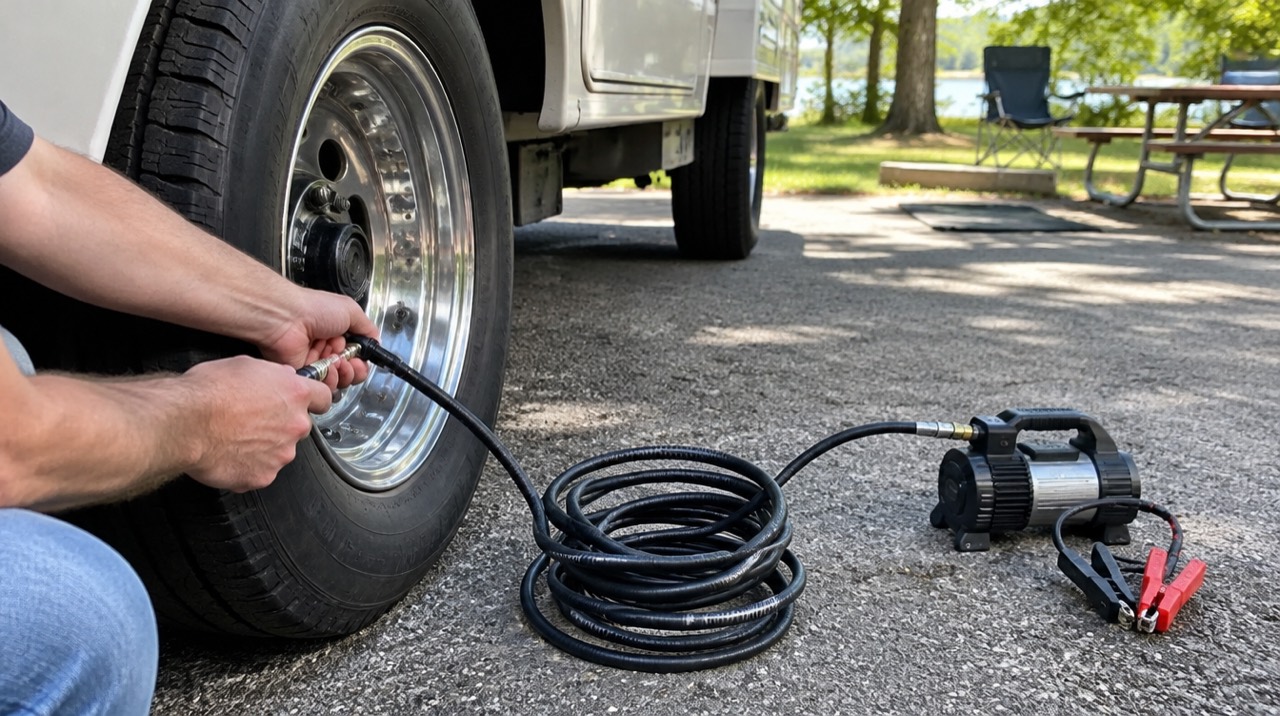
VIAIR’s 400P-RV (part 40047) is rated to 150 PSI maximum working pressure, 2.30 CFM at 0 PSI, a 33 percent duty cycle at 100 PSI and a 30-amp draw through heavy-duty battery clamps with an inline fuse. The kit includes a 30-foot primary hose plus a 30-foot extension, a 45-degree extended-reach chuck for dual rear wheels and a 90-degree twist-on chuck. VIAIR claims it takes a 275/80R22.5 tire from 80 to 90 PSI in under 3 minutes, weighs 10.75 lb, and lists an ambient range of -4°F to 158°F (VIAIR 400P-RV). We are naming it without a link because we could not confirm its current Amazon listing.
Who it is for: motorhomes on 19.5 and 22.5 inch tires, fifth wheels with long reach needs. Not for: glove-box storage; it is a 10-pound kit. Respect the duty cycle: at 33 percent, rest roughly twice as long as it runs.
Budget battery-clamp option for trailers: VIAIR 88P
The 88P is rated to 120 PSI, 1.97 CFM at 0 PSI, a 25-minute duty cycle at 30 PSI, a 20-amp draw and battery clamps, at 4.75 lb (VIAIR 88P). That is fine for 65 PSI load range D trailer tires and adequate for 80 PSI load range E, but 120 PSI is too close to most 19.5 and 22.5 inch motorhome pressures. Its duty rating is quoted at 30 PSI, so expect shorter runs at 80.
Who it is for: travel trailers and tow vehicles. Not for: Class A coaches.
Cordless top-off for trailers and Class C: what fits
Cordless inflators all quote 150 to 160 PSI maximums, which looks like plenty. The limit is battery energy and heat, not the number on the box. Some makers say so directly: WOLFBOX states its MegaFlow24 is “not suitable for RVs, pickup trucks, or large SUVs.” Use cordless units for quick top-offs of a few PSI on 80 PSI trailer tires and the tow vehicle, not for refilling a low coach tire.
Featured (disclosed relationship)
ZUZELT PS-986 cordless tire inflator. The listing gives a 20,000 mAh (74Wh) battery, dual 25 mm cylinders rated at 50 L/min, a 150 PSI maximum, a dual display and auto shutoff, and names cars, SUVs, pickups and motorcycles as uses. That is the largest battery and highest rated flow among the campaign inflators we checked, which makes it the most plausible cordless top-off tool for 80 PSI trailer tires.
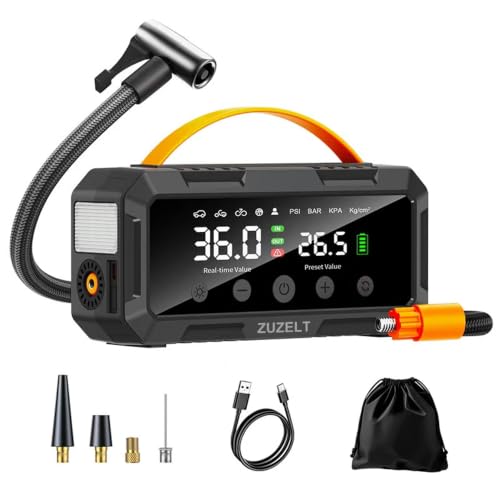
Not for: filling 19.5 or 22.5 inch motorhome tires from low pressure, or anything near 150 PSI. The listing does not mention RVs and we found no published duty cycle, runtime or operating temperature, so do not count on it as your only compressor.
If you want the strongest published cordless duty claim instead, the ETENWOLF Vortex S6 lists 160 PSI, 42 L/min at 0 PSI, a 19,200 mAh battery and a “100% duty cycle” claim for 31-inch pickup tires, per its listing (ETENWOLF Vortex S6). It is still a pickup-tire tool rather than a coach compressor. More pickup and LT options are in tire inflator for truck tires.

Smaller campaign inflators such as the Birtokom T06 (6,000 mAh, 150 PSI, rated for about four flat car tires per charge) are car-tire tools; they are not a match for RV tires and are covered in the best cordless tire inflator roundup.
Side by side
| Inflator | Power | Max PSI | Flow (maker, at 0 PSI) | Duty cycle (maker) | Dually chuck | Best for |
|---|---|---|---|---|---|---|
| VIAIR 400P-RV | 12V battery clamps, 30 A | 150 | 2.30 CFM | 33% at 100 PSI | Yes, 45-degree | Class A and C motorhomes |
VIAIR 88P $89.89Price as of November 15, 2026, 5:39 PM ET. Prices and availability are accurate as of the date/time indicated and are subject to change. Any price and availability information displayed on Amazon.com at the time of purchase will apply to the purchase of this product. | 12V battery clamps, 20 A | 120 | 1.97 CFM | 25 min at 30 PSI | No | Trailers, tow vehicles |
| ZUZELT PS-986$159.00Price as of November 15, 2026, 5:39 PM ET. Prices and availability are accurate as of the date/time indicated and are subject to change. Any price and availability information displayed on Amazon.com at the time of purchase will apply to the purchase of this product. | Cordless, 74Wh | 150 | 50 L/min | Not published | No | Trailer and tow-vehicle top-offs |
| ETENWOLF Vortex S6$129.99Price as of November 15, 2026, 5:39 PM ET. Prices and availability are accurate as of the date/time indicated and are subject to change. Any price and availability information displayed on Amazon.com at the time of purchase will apply to the purchase of this product. | Cordless, 19,200 mAh | 160 | 42 L/min | “100%” claim | No | Pickups, trailers |
1 CFM is about 28.3 L/min, so 2.30 CFM is roughly 65 L/min. All flow figures are at 0 PSI; flow into a 100 PSI tire is far lower. Check the current price on Amazon.
How to inflate RV tires safely
- Weigh the rig loaded for travel, by axle end if you can. A CAT scale gives axle weights; corner weighing gives ends.
- Look up your pressure in the tire maker’s current table for your size and load range, and check the wheel’s stamped maximum.
- Check cold, before driving or after the rig has sat for a few hours out of direct sun. Do not let air out of hot tires to hit a cold number.
- Clamp to the battery with the engine running, red to positive first, and route the hose clear of the exhaust and fan.
- Work tire by tire and rest the compressor per its duty cycle.
- Verify with a separate gauge and set every tire on an axle to the same pressure, as Michelin advises.
- Recheck after the first hour of driving on the first trip of the season; a slow leak shows up as one tire lower than its partner.
A TPMS is worth adding on any RV and towed trailer. Federal rules only require the warning on passenger vehicles to trigger at 25 percent under the recommended pressure (FMVSS 138), so a monitor helps but does not replace checking. For starting problems on the same rig, see best jump starter for an RV.
Mistakes to avoid
- Using the sidewall maximum as the target. It is a limit; your load sets the target.
- Exceeding the wheel rating. Some aluminum wheels are rated below the tire’s maximum.
- Running a 30-amp compressor off a 12V socket adapter. It will blow the fuse or overheat the wiring.
- Ignoring the inner dual. It is the tire most often found low. Fit extenders if the chuck cannot reach it.
- Trusting a cordless unit to refill a coach tire. It will drain or overheat long before 100 PSI.
Bottom line
- Class A and Class C motorhomes: VIAIR 400P-RV, for its 150 PSI rating, 100 PSI duty figure, 60 feet of hose and dually chuck.
- Travel trailers and tow vehicles: VIAIR 88P, or a high-capacity cordless unit for top-offs.
- Cordless top-offs on 80 PSI trailer tires: ZUZELT PS-986 or ETENWOLF Vortex S6, with the caveats above.
Whatever you buy, set pressure from weighed loads and the tire maker’s table, and check with a separate gauge.
Frequently asked questions
What PSI do RV tires need?
It depends on the tire and the weight on each axle end. Load range E trailer and Class C tires commonly top out at 80 PSI, while 19.5 and 22.5 inch motorhome tires can call for 95 to 130 PSI at full load in Toyo's RV inflation tables. Michelin says to weigh each axle end, use the heavier end to set pressure for the whole axle, and never exceed the wheel's stamped maximum.
Can a cordless tire inflator fill RV tires?
It can top off an 80 PSI trailer tire, slowly, if its maximum is well above your target and its battery holds out. It is the wrong tool for refilling 22.5 inch tires at 100 PSI or more. WOLFBOX, for example, says its MegaFlow24 is not suitable for RVs. A 12V compressor that clamps to the battery is the standard RV choice.
Why do RV compressors clamp to the battery instead of plugging into the 12V socket?
Current. A VIAIR 400P-RV draws up to 30 amps, while typical 12V accessory sockets are rated around 15 amps (Honda's manual lists 180 watts). Battery clamps let a bigger motor run without blowing a fuse, and the engine should be running while it works.
What is a dually chuck?
An angled or extended-reach air chuck that reaches the inner valve stem on dual rear wheels. VIAIR's 400P-RV kit includes a 45-degree extended-reach chuck for dual rear wheels plus a 90-degree twist-on chuck. Valve-stem extenders on the inner dual also help.
What duty cycle do I need for RV tires?
As much as you can get. VIAIR rates its 400P-RV at 33 percent at 100 PSI, which means it should rest about twice as long as it runs at that pressure. Plan breaks between tires, and expect a full round on a motorhome to take a while.
Keep planning
- Best Tire Inflator: Cordless, 12V Plug-In and Dual-Power Picks
Spec-based picks for the best tire inflator, including the best 12V plug-in and dual-power models, compared on flow, duty cycle, cord length and tire size.
Updated Nov 2026 - Best Cordless Tire Inflator for Cars, Bikes and Balls
Spec-based picks for the best cordless tire inflator: fill time, battery size, dual 12V power, PSI limits and which models suit cars, SUVs, bikes and balls.
Updated Oct 2026 - Best Motorcycle Tire Inflator: Compact, Accurate, Easy to Carry
Spec-based picks for the best motorcycle tire inflator: small cordless pumps that fit under a seat, read accurately at 28-42 PSI and reach tricky valve stems.
Updated Oct 2026