Jump Starters in Cold Weather: Lithium Limits and Fixes
In this guide
Lithium jump starters do work in winter, but two limits catch people out: the pack loses output as it gets colder, and it should not be charged below freezing even when it can still discharge well below it. The fix is simple: buy one size up the maker’s engine-rating ladder if you see regular sub-freezing mornings, keep the pack in the cabin or bring it inside, and charge it at room temperature. This guide is spec-based, built from manufacturers’ published temperature ranges read on 2026-10-28 and battery-chemistry references, not our own cold-chamber tests.
Disclosure: As an Amazon Associate I earn from qualifying purchases. ETENWOLF and WOLFBOX, featured below, pay a bonus commission through Amazon Creator Connections. See /disclosure/.
Why winter is a double hit
On a cold morning two things go wrong at once.
The car battery is weaker. A lead-acid starting battery’s chemistry slows down in the cold. AAA, as quoted in news coverage, puts the loss at about 35 percent of a battery’s strength at 32°F and about 60 percent at 0°F; NAPA’s guide gives roughly half at 0°F. The exact figure varies with battery age and type, but the direction does not. That is also why battery makers rate cold cranking amps (CCA) at 0°F: it is the hard case.
The engine is harder to turn. Cold oil is thicker, and diesels add glow-plug or grid-heater load before cranking. The starter needs more current at the same moment the battery can deliver less.
The lithium pack is weaker too. Battery University’s guide to charging at high and low temperatures notes that internal resistance rises in all batteries as they get cold, which noticeably cuts lithium-ion discharge performance. A pack that starts your engine easily in October has less to give in January.
None of the makers whose listings we read publishes how much output its pack loses at a given temperature, so there is no exact derating number to apply. What you can do is build in margin.
Operating temperature vs charging temperature
These are two different specs, and the second one is stricter.
| Pack | Stated operating range | Stated charging range | Source |
|---|---|---|---|
| NOCO Boost GB40 | about -22°F to 122°F | 32°F to 104°F | retailer data sheet |
| GOOLOO A3 | not in text read | 14°F to 113°F | Amazon listing |
| GOOLOO GP4000 | -4°F to 140°F | not in text read | Amazon listing |
| ETENWOLF J1 | -4°F to 140°F | not in text read | Amazon listing |
| VACASSO Z08 | -4°F to 140°F | not in text read | Amazon listing |
| Odifni 8-in-1 800A | -4°F to 140°F | not in text read | Amazon listing |
| Giroago 6000A | -4°F to 122°F | not in text read | Amazon listing |
| WOLFBOX MV16 | low-temp protection; no range in text read | not in text read | Amazon listing |
Checked 2026-10-28. Your manual is the authority; confirm the ranges printed for your unit.
Why charging is stricter: Battery University explains that charging a consumer lithium-ion cell below 32°F (0°C) can plate metallic lithium onto the anode. The damage is permanent, reduces capacity and safety, and can happen while the pack appears to charge normally. Many packs have a low-temperature cutoff for exactly this reason, which is what a “low-temperature protection” line in a listing usually means.
The practical rule: never charge the pack in a cold car, even from the USB port while you drive. Bring it inside, let it reach room temperature, then charge.
How much headroom to buy
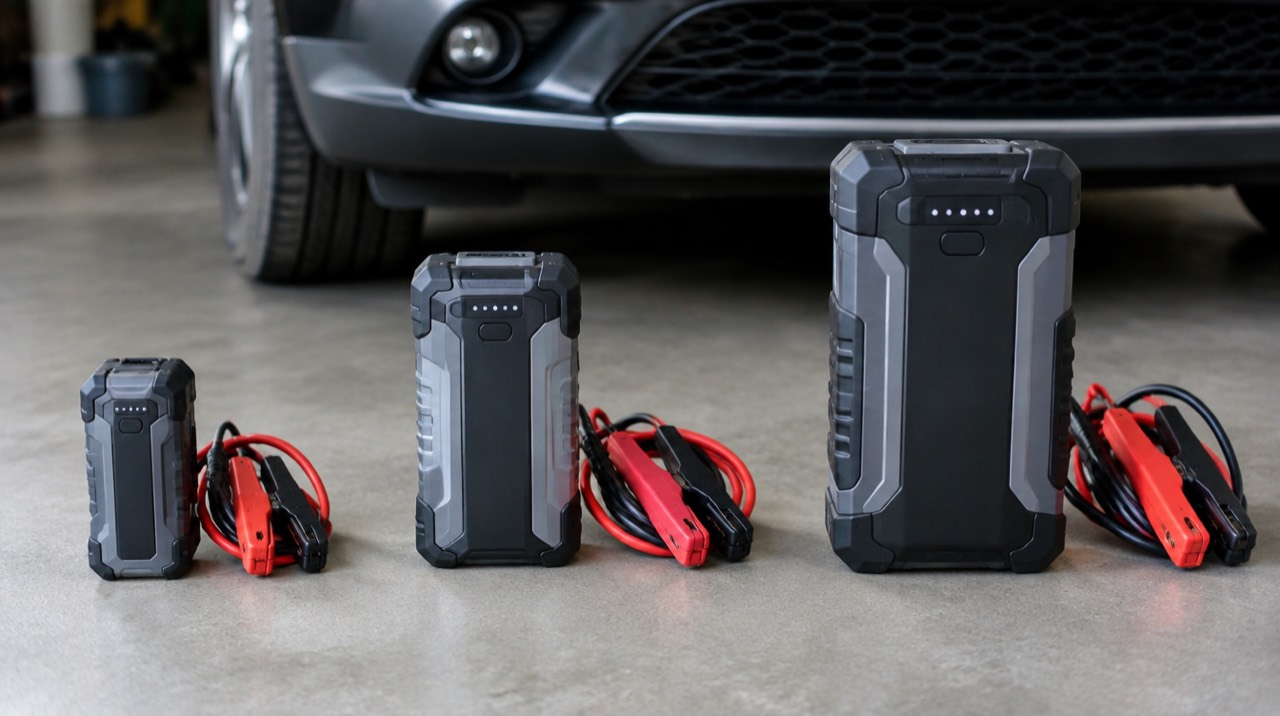
Because no one publishes a cold derating curve, use the maker’s own ladder. Find the smallest pack whose rating covers your engine for your fuel, then go one rung up if any of these apply:
- Winter lows regularly sit below about 20°F where you park.
- The car sits outside, or for more than a week at a time.
- The battery is more than three or four years old.
- It is a diesel, or a V8 with a large displacement.
For a 2.0L four-cylinder that might mean a pack rated for 6L gas instead of the smallest 4L class. For a 5.7L V8, it means a 7L or 8L-gas pack rather than one rated at exactly 6L. What size jump starter do I need has the full engine table, and the diesel truck guide covers heavy-duty pickups.
Where to keep the pack in winter
- Cabin over trunk. The cabin warms up when you drive and stays a few degrees warmer overnight than an uninsulated trunk or truck bed toolbox.
- Indoors overnight in a deep freeze. If tomorrow’s low is below the pack’s stated range, carry it in at night and out in the morning. A pack at 60°F performs better than one at 0°F.
- Pocket-warm it before use. If the pack has been in a frozen car, putting it inside your jacket or in the running cabin of a helper vehicle for 10 to 15 minutes is a common, low-risk way to bring its temperature up before you try. Do not use a heater, open flame or engine block to warm it.
- Keep it charged. Several listings give storage advice: Giroago suggests starting a car only when the pack is above 75 percent, and Odifni says to keep it above 30 percent for jump starting. Cold plus low charge is the worst case. Check it before a cold snap, not during one. How long does a jump starter hold a charge covers recharge intervals.
Preheat models for very cold climates
Some lithium packs include a preheat function that warms the internal cells before you try to start. Schumacher’s ProSeries DSR164 is described by a retailer as pre-heating its battery for use down to -13°F, and Clore’s Jump-N-Carry lithium units have a preheat switch that warms the pack and signals when it is ready, according to trade-press coverage. Preheat uses some of the pack’s energy and takes a few minutes, but if you live where -10°F mornings are normal, it is the feature to look for. Check the manufacturer’s current spec page before buying, as model names and ranges change.
An alternative for extreme cold is a lead-acid (AGM) booster such as Clore’s Jump-N-Carry JNC660, which Clore lists at 1700 peak amps and 425 cranking amps on its JNC660 spec page. It weighs 18 lb, so it lives in a shop or truck, not a glove box.
A cold-morning jump, step by step
- Warm the pack first if it spent the night below freezing, as above.
- Clear snow and ice from the battery terminals so the clamps bite on metal.
- Connect positive first, then negative to the terminal or a chassis ground, per your manual.
- Turn off heater, lights and rear defroster. Every accessory steals current from the starter.
- Crank for no longer than your manual allows, usually a few seconds, then rest. On a diesel, wait for the wait-to-start light first.
- Remove the clamps promptly once the engine runs, then drive for a good while, or put the car battery on a charger: a cold battery recharges slowly.
- Recharge the pack indoors before it goes back in the car.
Full clamp-order detail and rest intervals from the manuals are in how to use a jump starter.
Mistakes to avoid
- Charging the pack in a freezing car. It can damage the cells without any visible sign.
- Buying exactly your engine size. Winter takes the margin away.
- Leaving it in the bed toolbox all winter. That is usually the coldest place on the vehicle.
- Cranking with every accessory on.
- Assuming the battery is fine after a jump. If it needed a jump at 10°F, test it; a weak battery fails again on the next cold morning. Can a jump starter charge a dead battery? explains why the pack is not a charger.
Bottom line
A lithium jump starter is a good winter tool if you size it one step above your engine, keep it warm and charged, and charge it only above freezing. If your mornings routinely go below the pack’s stated range, choose a preheat model or a lead-acid booster. Check the current price on Amazon and the temperature ranges in the manual before you rely on a pack in a cold snap.
Frequently asked questions
Do lithium jump starters work in freezing weather?
Most do, within their stated operating range. Many current listings give -4°F to 140°F, and NOCO's GB40 data sheet gives about -22°F to 122°F. Output falls as the pack gets colder, and the car battery is weaker too, so buy a pack rated above your engine and keep it warm when you can.
Can I charge a jump starter in a cold car?
Do not charge it below freezing unless the manual says you can. Lithium-ion cells can be damaged by charging below 32°F (0°C), and retailer data for NOCO's GB40 gives a 32°F to 104°F charging range. Bring the pack indoors to charge.
Should I keep my jump starter in the car in winter?
It is fine to store it in the car if the temperature stays inside the pack's stated range, but it will work better warm. In very cold weather, keep it in the cabin rather than the trunk, or bring it inside overnight and carry it out in the morning.
What is a preheat jump starter?
Some packs, such as certain Schumacher and Clore Jump-N-Carry lithium models, have a switch that warms the internal battery before a cold start. It takes a few minutes and uses some of the pack's energy, but it helps output at very low temperatures.
How much bigger should my jump starter be for winter?
No maker publishes a cold derating figure, so this is a judgment call. A common editorial rule is to go one rung up the maker's own ladder, for example from a 6L-gas pack to a 7L or 8L-gas pack, if you see regular sub-freezing mornings.
Keep planning
- How to Use a Portable Jump Starter Safely (Step by Step)
How to use a portable jump starter safely: clamp order, how long to crank, rest between attempts, boost and override modes, and what to do if it fails.
Updated Oct 2026 - Peak Amps vs Cranking Amps: Reading Jump Starter Specs
Peak amps vs cranking amps explained: what each rating means, why peak figures can't be compared across brands, and the spec to use when choosing a jump starter.
Updated Oct 2026 - What Size Jump Starter Do I Need? Amps by Engine and Climate
What size jump starter do you need? Match the maker's gas or diesel engine rating to your displacement, then size up for cold climates. Tables and examples inside.
Updated Oct 2026