How to Use a Portable Jump Starter Safely (Step by Step)
In this guide
To use a portable jump starter, charge it first, turn off the car’s lights and accessories, clamp red to the battery’s positive terminal and black to the negative terminal or a bare metal ground, switch the pack on, wait for its ready light, then start the car. Disconnect in reverse: black off first, then red. The details that differ between models, how long to crank, how long to rest, and when to use boost or override, come from the manuals, so this guide quotes them and tells you what to check in yours.
Before you start: four checks
- The pack is charged. A pack showing one bar may not have enough for a cold engine. Most packs show charge on a row of LEDs or a screen.
- The battery is 12V and the right chemistry. NOCO’s GB40 user guide tells you to verify the voltage and chemistry of the battery first, and the edition we read says that model is for 12-volt lead-acid batteries. Some newer packs support other chemistries; check yours, and never connect a 12V pack to a 24V system.
- The battery is not damaged. If the case is cracked, bulging or leaking, or you smell rotten eggs, do not jump it. Get roadside help.
- Read the vehicle’s manual. Many cars, especially those with the battery in the trunk or under a seat, have dedicated remote jump points under the hood. Use them if your car has them.
Turn off the headlights, radio, heater and A/C, and unplug phone chargers. NOCO’s guide lists this as a step before starting, because loads pull current the starter needs.
Step by step
1. Connect the clamps to the pack (if they detach). Many packs use a plug-in cable. Make sure it is fully seated.
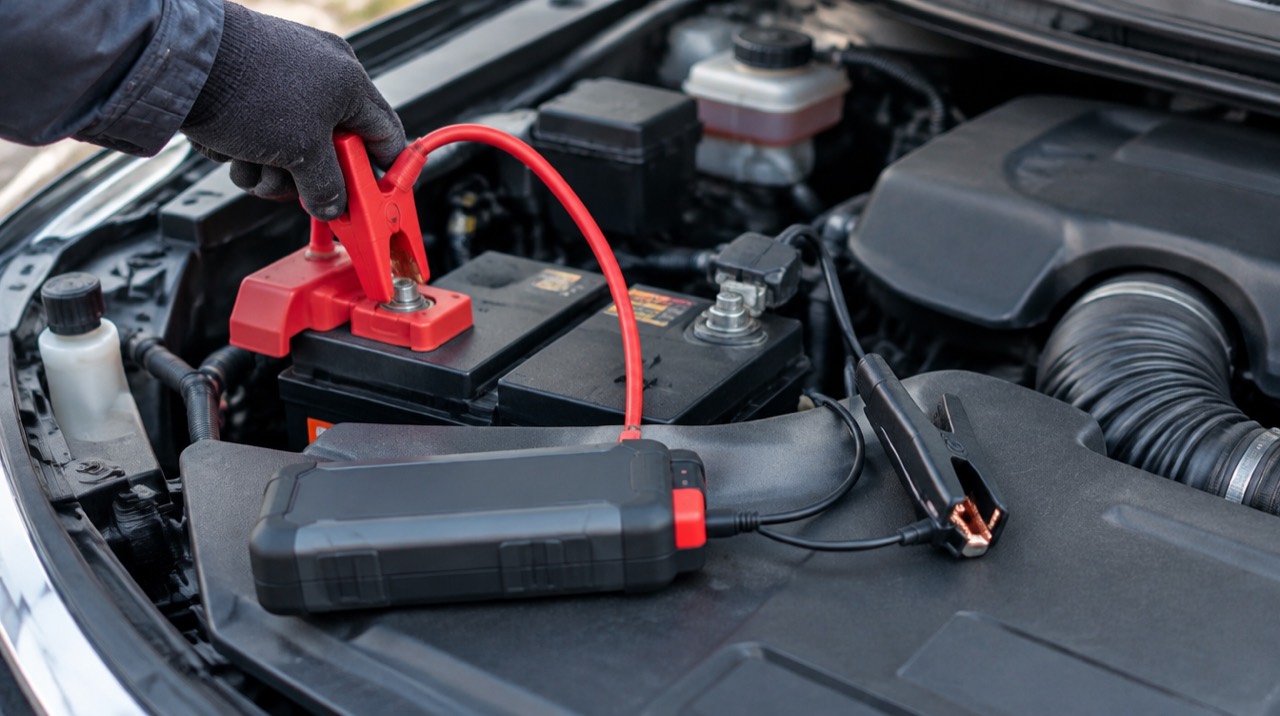
2. Red clamp to positive (+). The positive terminal is usually marked +, POS or P and often has a red cover. Bite onto clean metal on the terminal or clamp bolt, not the plastic cover.
3. Black clamp to negative (-) or ground. NOCO’s guide allows the negative terminal or the vehicle chassis. Many car manuals prefer an unpainted metal point on the engine or a dedicated ground stud away from the battery, which keeps any spark away from the battery top. Either way, the jaws must bite bare metal.
4. Keep the clamps apart and clear of moving parts. Route the cables away from the fan and belts. Do not let the two clamps touch once the pack is on.
5. Switch the pack on and wait for “ready.” On the GB40, a white Boost LED means ready and a red Error LED means the clamps are reversed; swap them and the error clears. Other brands use a green light or a screen message. If the pack shows nothing at all with the clamps on properly, the battery may be too low to detect (see boost and override below).
6. Start the car. Turn the key or press start as normal. NOCO says most vehicles start immediately, but some need the pack connected for up to 30 seconds before they will start.
7. If it does not start, wait. NOCO’s GB40 guide says to wait 20 to 30 seconds between attempts, to make no more than five consecutive attempts within 15 minutes, and then to let the pack rest for 15 minutes. The rest protects both the pack and your car’s starter motor. Other brands give their own figures; follow yours.
8. Once the engine is running, disconnect. Switch the pack off if it has a power button, remove the black clamp, then the red. Close the hood and store the clamps so the jaws cannot touch.
9. Keep the engine running and recharge both. Drive for a while or put the car battery on a charger, and recharge the jump pack as soon as you can. A jump starter starts the car; it does not refill a weak battery. Can a jump starter charge a dead battery? explains why.
Boost and manual override modes
Most packs refuse to send power until they detect a battery, which is how they prevent sparks and reverse-polarity damage. A battery that is almost completely flat may not register. That is what boost and override buttons are for, and they work differently by brand:
| Pack (per its manual or listing) | When boost applies | What changes |
|---|---|---|
| NOCO GB40 (user guide) | Battery below 2 volts, Boost LED stays off | Hold Manual Override for 3 seconds; spark-proof and reverse-polarity protection are disabled; switch the pack off before removing clamps |
| GOOLOO GP3000 (listing) | Battery below 9V | BOOST mode for low-voltage batteries |
| GOOLOO GP4000 (listing) | Extremely low battery voltage | Press BOOST to force the start |
| AstroAI S8 (listing) | Voltage under 9V, green light flashes | Press boost, then start |
NOCO’s warning on override is blunt: it is for 12V lead-acid batteries only, it disables the protections, and the clamps will spark if they touch. Use it only after checking polarity twice. If you are unsure, the manual’s own advice is not to attempt it and to seek professional help.
What the lights and errors usually mean
| What you see | Likely cause | What to do |
|---|---|---|
| Red error light as soon as you switch on | Clamps reversed | Swap the clamps |
| Nothing lights with the clamps on | Battery too low to detect, or pack not charged | Check the pack’s charge; use boost or override per the manual |
| Error light blinking during use (GB40) | Pack’s internal battery too hot | Stop, let it cool, move it somewhere cooler |
| Engine cranks slowly but will not catch | Pack too small for the engine, or pack low on charge | Rest the pack, try again, or use a larger pack |
| Engine cranks normally but will not fire | Not a battery problem | Stop jumping; fuel, ignition or security issue |
| Clicking, no crank, good connections | Possibly the starter or a terminal fault | Clean terminals, check clamp bite, get help |
Error codes vary; your pack’s manual has its own table. If the car still will not start after the attempts your manual allows, stop. Repeated cranking overheats the starter and the pack.
Safety rules from the manuals
- No sparks near the battery top. Lead-acid batteries can give off explosive gas; manufacturers’ warnings about explosion and fire are why spark-proof clamps exist and why many car manuals prefer an engine ground for the black clamp.
- Never touch the clamps together while the pack is on, and never in override mode.
- Do not charge and use the pack at once. NOCO recommends against charging and discharging the unit at the same time.
- Mind the heat. Lithium packs warn when they get hot. Stop when they do.
- Do not jump a frozen battery. If the battery case is bulged or ice is visible, it may be frozen. Let it thaw and have it checked.
- Look up recalls. Lithium jump starters have been recalled for overheating; the CPSC’s 2015 Whistler Jump&Go recall is one example. Search your brand on cpsc.gov and register the product. Lithium jump starter safety covers storage.
Common mistakes
- Using a pack that has sat flat for a year. Makers suggest recharging every few months: GOOLOO says every 2 to 3 months for the GP4000, every 90 days for the GP3000.
- Clamping onto paint, plastic or a corroded terminal. Clean the contact point or move to bare metal.
- Cranking without pause. Respect the wait times in the manual.
- Disconnecting red first. Black off first, red last.
- Leaving the pack in a hot car all summer. AstroAI warns against sun-baked trunks; heat ages lithium cells.
- Buying a pack that is too small. If a properly connected, charged pack cannot turn your engine, check what size jump starter you need.
After the jump
If you do not own a pack yet and are stuck with a set of cables and a helpful driver, the clamp order is the same idea with a second car in the loop; jump starter vs jumper cables compares the two approaches, including when cables are the better tool.
Have the battery and charging system tested, especially if the battery is more than three or four years old or went flat without an obvious cause such as lights left on. Auto parts stores and repair shops can load-test a battery; ask what they charge. Recharge the jump pack, put it back in the car, and keep a basic kit with it: Ready.gov’s car kit list includes jumper cables, flares or a reflective triangle and a blanket. If you are choosing a pack, best portable jump starter sizes the options by engine. In cold climates, jump starters in cold weather covers keeping the pack warm enough to work.
Frequently asked questions
Which clamp goes on first with a jump starter?
Red first, to the positive (+) terminal, then black to the negative (-) terminal or a bare metal ground point on the engine or chassis. Remove them in reverse order: black first, then red. That order is for negative-ground vehicles, which covers almost every modern car; NOCO's GB40 guide notes the reverse applies to the rare positive-ground system.
How long should I crank with a jump starter?
Follow your pack's manual. NOCO's GB40 guide says some vehicles need the pack connected for up to 30 seconds before starting, to wait 20 to 30 seconds between attempts, and not to make more than five attempts in 15 minutes before letting the pack rest for 15 minutes.
Do I need to leave the jump starter connected after the car starts?
No. Once the engine is running, switch the pack off if it has a power button, remove the black clamp, then the red, and let the car's alternator take over. A jump starter is not a charger; drive the car or put the battery on a proper charger afterwards.
What does boost or manual override mode do?
It forces the pack to deliver power when the battery is too low for the pack to detect. On NOCO's GB40 that threshold is below 2 volts, and override turns off the spark-proof and reverse-polarity protection. GOOLOO and AstroAI packs signal boost when battery voltage is under about 9 volts. Use override only after double-checking polarity, and only as your manual describes.
Why won't my car start even with the jump starter connected?
Common causes are a pack that is not charged, clamps on corroded terminals or painted metal, accessories left on, or a pack too small for the engine. If the engine cranks normally but will not fire, the battery is not the problem. If several attempts fail, stop and get help rather than overheating the pack or the starter.
Keep planning
- Jump Starters in Cold Weather: Lithium Limits and Fixes
Do lithium jump starters work in cold weather? Operating vs charging temperature limits, how much headroom to buy, where to store the pack, and preheat models.
Updated Oct 2026 - Peak Amps vs Cranking Amps: Reading Jump Starter Specs
Peak amps vs cranking amps explained: what each rating means, why peak figures can't be compared across brands, and the spec to use when choosing a jump starter.
Updated Oct 2026 - What Size Jump Starter Do I Need? Amps by Engine and Climate
What size jump starter do you need? Match the maker's gas or diesel engine rating to your displacement, then size up for cold climates. Tables and examples inside.
Updated Oct 2026