Best 24V Jump Starter for Semis, Buses and Heavy Equipment
In this guide
The best 24V jump starter is one that is genuinely rated for 24V systems, set or detected correctly before you connect, and sized for the engine on the maker’s own liter rating. In practice that narrows the field to a short list of 12V/24V heavy-duty packs: NOCO’s Boost Max GB500 class, TOPDON’s V4000 HD, and Clore’s lead-acid Jump-N-Carry JNC1224. Before you buy any of them, confirm your vehicle is actually 24V; many big trucks are not. This is a spec-based guide built from manufacturer pages and retailer spec sheets checked on 2026-10-28, not tests we ran.
Step one: is it really a 24V system?
This is the question that decides everything, and it is easy to get wrong in both directions.
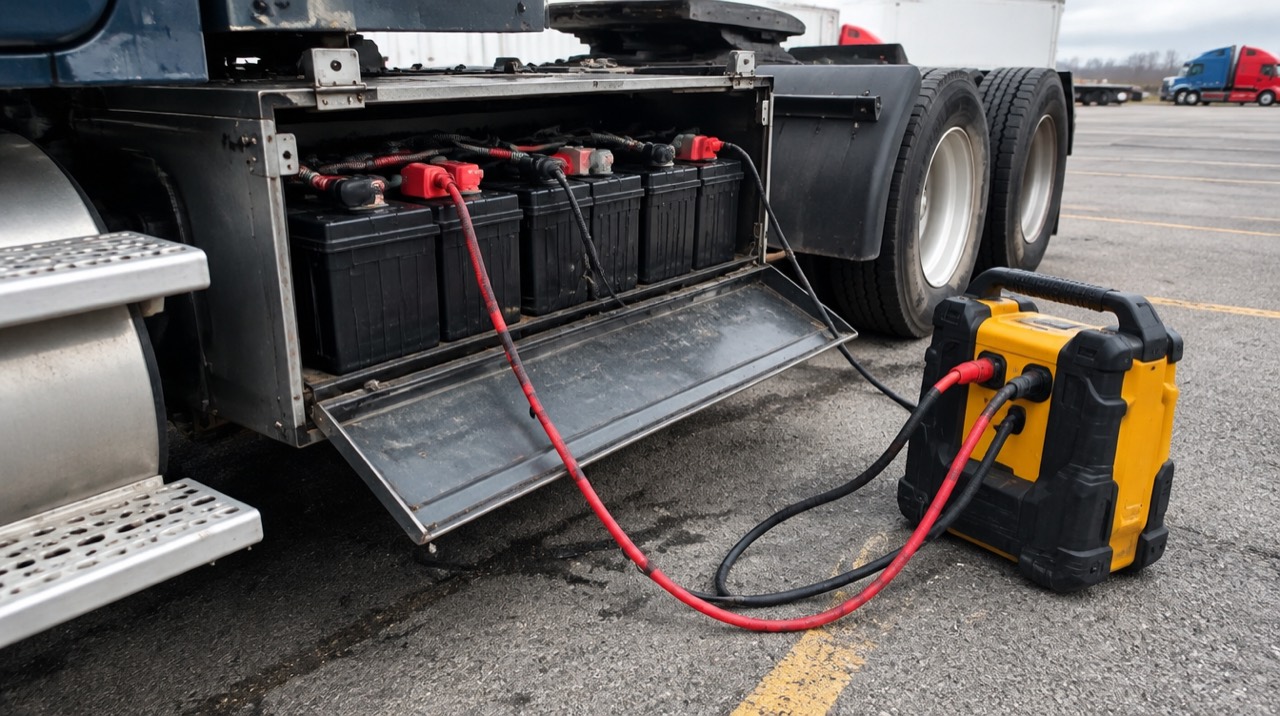
A 24V starting system uses two 12V batteries (or two banks of them) wired in series: the positive post of one battery connects to the negative post of the next, and the starter is fed from the two outer terminals. Common places to find 24V include military vehicles, many European and Asian trucks, some transit and coach buses, and plenty of construction, mining, farm and marine equipment.
A 12V system with several batteries is wired in parallel: positives joined to positives, negatives to negatives. That gives more reserve and cranking current at 12V. Many North American highway tractors and large motorhomes work this way. A 2004 Freightliner XC motorhome chassis spec sheet, for example, lists diesels up to 8.9 liters with 12-volt starting from two batteries (Freightliner XC spec sheet). A big diesel and a box full of batteries do not by themselves mean 24V.
How to check:
- Owner’s manual or operator’s manual. The electrical or specifications section states the system voltage.
- Starter and alternator labels. These often state 12V or 24V.
- The cables. Trace them. Series wiring links one battery’s positive to the other’s negative; parallel wiring links like to like.
- A voltmeter. Across the two outermost terminals that feed the starter, a healthy 24V system reads about 24 to 25.5 volts at rest; a 12V system reads about 12 to 12.8.
Some trucks also run a mixed setup, such as a 24V starter with 12V accessories through a series-parallel switch. If your vehicle has one, its manual governs how to jump it, and that is a job to do exactly as written.
Why a 12V pack on a 24V system is a mistake
A 12V pack connected across a 24V system is outmatched: the vehicle’s batteries sit at roughly twice the pack’s voltage. Makers are explicit about it. HDJFLU’s listing says its 12V pack “should not be used on a 24V vehicle”, and NOCO’s Boost X FAQ says that line is for 12V vehicles and points 24V owners to its Boost Max (GB500) instead. Even NOCO’s big GBX155 (rated for 10L gas and 8L diesel) is 12V only, despite at least one retailer listing it as 12V and 24V. If you are reading a listing that mentions 24V, look for an explicit 24V output rating, not just the number 24 somewhere in the copy.
Spec comparison: 12V/24V jump packs
| Pack | Type | Voltage selection | 12V rating | 24V rating | Engine rating | Weight / battery |
|---|---|---|---|---|---|---|
| NOCO Boost Max GB500 | Lithium | Knob (12V white, 24V blue) | 6,250A peak | about 3,125A peak (retailer copy) | gas and diesel up to 45L | 266Wh |
| TOPDON V4000 HD | Lithium (LiFePO4) | Automatic | 4000A peak | 3000A peak (retailers) | gas and diesel up to 16L | 204.8Wh listed by one retailer |
| Clore Jump-N-Carry JNC1224 | Lead-acid (Clore “PROFORMER”) | Changeover on unit | 3400 peak / 850 cranking | 1700 peak / 425 cranking | not liter-rated | 40 lb, 46 in #2 AWG leads |
Sources: Clore’s JNC1224 page, TOPDON’s V4000 HD page and launch release, NOCO’s GB500+ interface page and authorized retailers, all checked 2026-10-28. No Amazon listing for these three could be verified when this guide was written, so they are named without links; check current availability with the maker or a truck-parts dealer.
Two caveats from the sources. Several retailers list the GB500 as special order, and at least one distributor flags it as discontinued, so availability may be thin. TOPDON’s own release describes a “64,000mAh” battery, which does not match the 204.8Wh figure one retailer gives; treat the battery capacity as unconfirmed and compare on the 16L engine rating instead.
The picks
Biggest rating for 24V heavy equipment: NOCO Boost Max GB500
The GB500 is the heavy end of NOCO’s line: a 12V and 24V lithium pack rated by retailers for gas and diesel engines up to 45 liters, with a 266Wh battery. The voltage is chosen with a knob, and the interface lights white in 12V mode and blue in 24V mode. NOCO’s manual is blunt that the knob must match the system you are jump starting, and it describes a Manual Override (held for three seconds) that disables the safety protection, so that mode is for situations the manual describes and nothing else.
Who it suits: fleet and equipment owners who need one pack for both 12V pickups and 24V machines and want the highest engine rating on the list. Who it does not: anyone on a budget or who needs it next week; retailer prices are high and stock is patchy.
Lighter lithium with automatic detection: TOPDON V4000 HD
TOPDON says the V4000 HD detects 12V or 24V automatically, and retailers list it at 4000A peak in 12V and 3000A in 24V, rated for gas and diesel engines up to 16 liters, with LiFePO4 cells and a 65W USB-C PD input for recharging. Retailer copy lists up to 60 starts at 12V and 30 at 24V. A 16L rating covers the large majority of on-road heavy diesels on paper.
Who it suits: owner-operators and service techs who want auto-detection (one less thing to set wrong) and a pack light enough to carry in a cab. Who it does not: buyers who want a published, consistent battery spec; the capacity figures disagree across TOPDON’s release and retailers.
Shop-proven lead-acid: Clore Jump-N-Carry JNC1224
Clore’s JNC1224 is a lead-acid booster with 46-inch #2 AWG welding-cable leads, industrial clamps, a built-in automatic charger and a volt gauge. Clore lists 3400 peak and 850 cranking amps at 12V, and 1700 peak and 425 cranking amps at 24V. It weighs about 40 lb. Clore is one of the few makers that publishes a cranking-amp figure at all, which makes it easier to compare to a vehicle battery’s rating than lithium packs that publish only peak amps.
Who it suits: shops and yards where the pack lives on a cart and long, heavy cables matter more than weight. Who it does not: anyone carrying it in a truck cab, or anyone who will let it sit uncharged: lead-acid boosters need to stay on charge between uses. One retailer lists it as discontinued by the manufacturer, so confirm availability.
Connecting a pack to a 24V system
Follow the pack’s manual and the vehicle’s manual; they govern. In outline:
- Confirm the system voltage (above), and set the pack’s voltage selector if it has one.
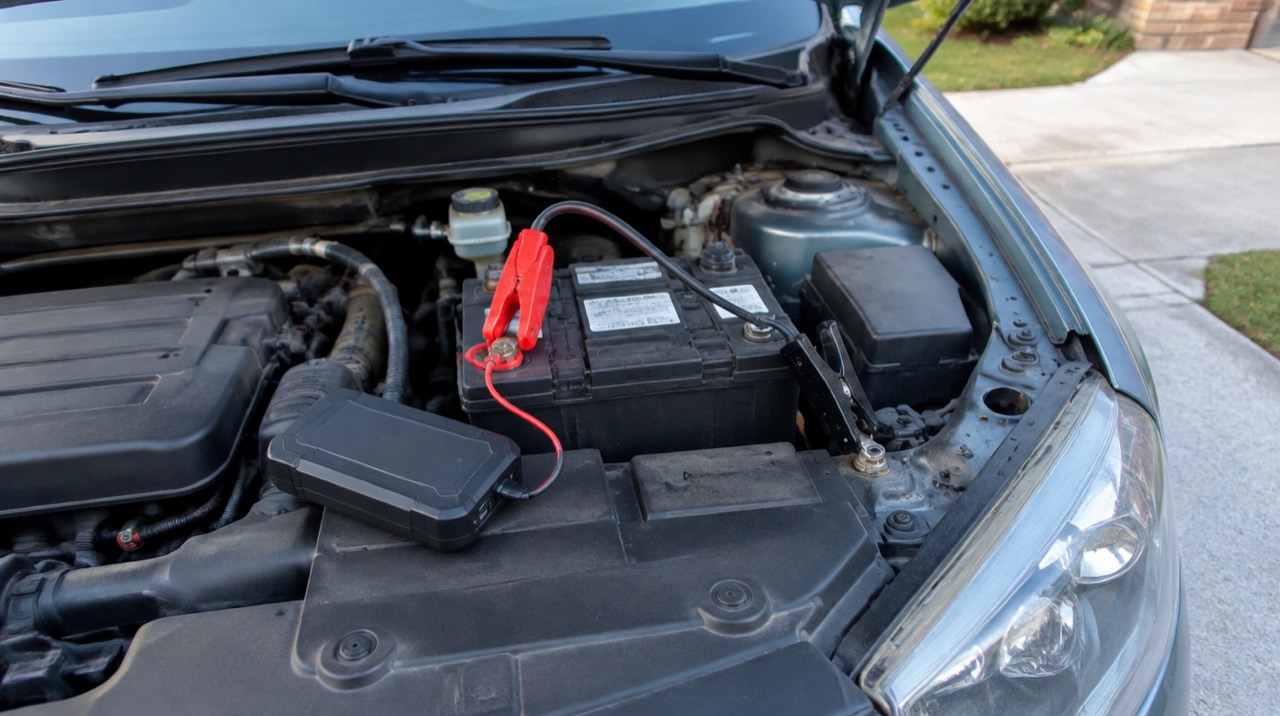
- Find the correct terminals. On a series pair, you connect across the two outer terminals: the positive that feeds the starter and the negative that goes to ground. Many trucks provide dedicated jump studs; use them if the manual says to.
- Clamp positive first, then negative (or the chassis ground point the manual names), keeping the clamps apart.
- Crank in short bursts and rest between attempts as the pack’s manual specifies. On a diesel, let the intake heater or glow plugs finish before cranking.
- Disconnect in reverse order once the engine runs.
The 12V basics are the same as in how to use a jump starter, and where to connect a jump starter covers remote jump posts.
Cold, heavy diesels: size with margin
Big diesels in winter are the hardest starts there are. Lithium packs lose output in the cold, so do the vehicle’s batteries, and a series pair with one weak battery drags down the whole system. Size the pack with headroom over the displacement, keep it in the cab rather than the toolbox overnight, and charge the vehicle’s batteries properly once the engine runs: a jump pack is not a battery charger. Jump starters in cold weather explains the temperature effect.
If your heavy diesel turns out to be 12V, a 12V pack with a large diesel rating is the cheaper route; best jump starter for diesel trucks compares 12V packs rated up to 12L diesel, and what size jump starter do I need covers sizing.
Safety notes
Large lithium packs store a lot of energy. The North American safety standard for portable power packs, including the jump-start function, is UL 2743; check for the mark on the product. Keep the pack out of direct sun on the dash, store it within the manual’s temperature range, and retire any pack that swells, smells or gets hot while idle. Lithium jump starter safety covers recalls and storage.
Mistakes to avoid
- Assuming many batteries means 24V. Parallel 12V banks are common on big trucks and motorhomes.
- Trusting “24V” in a listing without a 24V output rating. Some 12V-only packs are mislabeled by sellers.
- Leaving a switchable pack on the wrong setting. Check the knob every time.
- Jumping one battery of a series pair with a 12V pack. Use a 24V pack across the system, as the manuals describe.
- Using Manual Override to force a start. It disables protections; use it only as the manual allows.
Bottom line
- Highest rating, both voltages: NOCO Boost Max GB500 (12V/24V, up to 45L), if you can find one.
- Lightweight lithium with auto-detect: TOPDON V4000 HD (12V/24V, up to 16L).
- Shop cart and long cables: Clore Jump-N-Carry JNC1224 (850 / 425 cranking amps).
- Truck turned out to be 12V: a 12V diesel-rated pack instead.
Confirm the system voltage first, then the rating on the pack’s own label.
Frequently asked questions
Can I use a 12V jump starter on a 24V truck?
No. A 24V starting system needs a pack built and set for 24V. Makers of 12V-only packs say so directly; HDJFLU's listing, for example, says its pack should not be used on a 24V vehicle, and NOCO's Boost X FAQ points 24V users to its Boost Max line instead.
How do I know if my truck is 12V or 24V?
Check the owner's manual or the starter label first. On the batteries themselves, a 24V system has at least two 12V batteries wired in series, positive of one to negative of the next, and a voltmeter across the two outer terminals reads roughly 24 to 25.5 volts. Many North American highway tractors with several batteries are actually 12V, wired in parallel.
What is the difference between a 12V/24V switchable pack and an automatic one?
A switchable pack such as NOCO's GB500 uses a knob you set to 12V or 24V before connecting; its manual says the setting must match the battery system. An auto-detecting pack such as TOPDON's V4000 HD reads the system voltage itself. Either way, confirm the voltage before you clamp on.
Is a lithium or lead-acid 24V jump pack better?
Lithium packs like the GB500 and V4000 HD are much lighter for their rating. Lead-acid boosters like Clore's JNC1224 are heavy (about 40 lb) but use thick welding-cable leads and are a long-standing shop tool. Fleet shops often pick lead-acid for durability and long cables; a single operator who carries the pack in a cab often prefers lithium.
Why is the 24V amp rating lower than the 12V rating on the same pack?
In 24V mode the pack delivers its energy at twice the voltage, so makers quote about half the current. Clore lists the JNC1224 at 850 cranking amps at 12V and 425 at 24V; TOPDON lists the V4000 HD at 4000A at 12V and 3000A at 24V.
Keep planning
- Best Jump Starter for Diesel Trucks: What Size Actually Works
How to pick the best jump starter for a diesel truck: match the maker's diesel liter rating, not peak amps, plus dual batteries, 24V systems and cold starts.
Updated Oct 2026 - Best Jump Starter for Small Cars and 4-Cylinder Engines
The best jump starter for small cars and 4-cylinder engines is a compact 12V pack rated 6L to 8L gas. How to size it, what to skip, and spec-based picks.
Updated Oct 2026 - Jump Starter With Air Compressor: Worth the Combo?
Is a jump starter with air compressor worth it? Spec-based look at WOLFBOX, GOOLOO, AstroAI and ETENWOLF combos vs a separate pack and inflator.
Updated Oct 2026