Cordless vs 12V Tire Inflator: Speed, Duty Cycle, Convenience
In this guide
Cordless vs 12V tire inflator comes down to how much air you move at a time. For monthly top-ups on cars and small SUVs, a cordless inflator wins on convenience: it fits a glove box, runs without the engine on and many now match small 12V units on published airflow. For big truck, RV or off-road tires, or refilling a flat from near zero, a 12V compressor wins because the vehicle’s battery keeps it running and larger models publish longer duty cycles. This is a spec-based comparison built from manufacturer listings and spec pages read on 2026-10-28, not a timed test.
Disclosure: As an Amazon Associate I earn from qualifying purchases. Some brands featured below pay a bonus commission through Amazon Creator Connections. See /disclosure/.
The short answer
| Your situation | Pick | Why |
|---|---|---|
| Car or crossover, top-ups a few PSI at a time | Cordless | Fast to grab, no cord, engine off |
| Bikes, balls and car tires from one tool | Cordless | Presets and small nozzles; light |
| Half-ton pickup, light truck (LT) tires, RV | 12V battery-clamp compressor | Long duty cycle, larger tires |
| Airing back up after off-road | 12V battery-clamp compressor | Four large tires from low pressure |
| Want both in one | Dual-power (battery plus 12V cord) | See dual-power tire inflators |
| Car in a very cold climate | 12V, or dual-power | Lithium packs lose capacity in the cold |
How the two types work
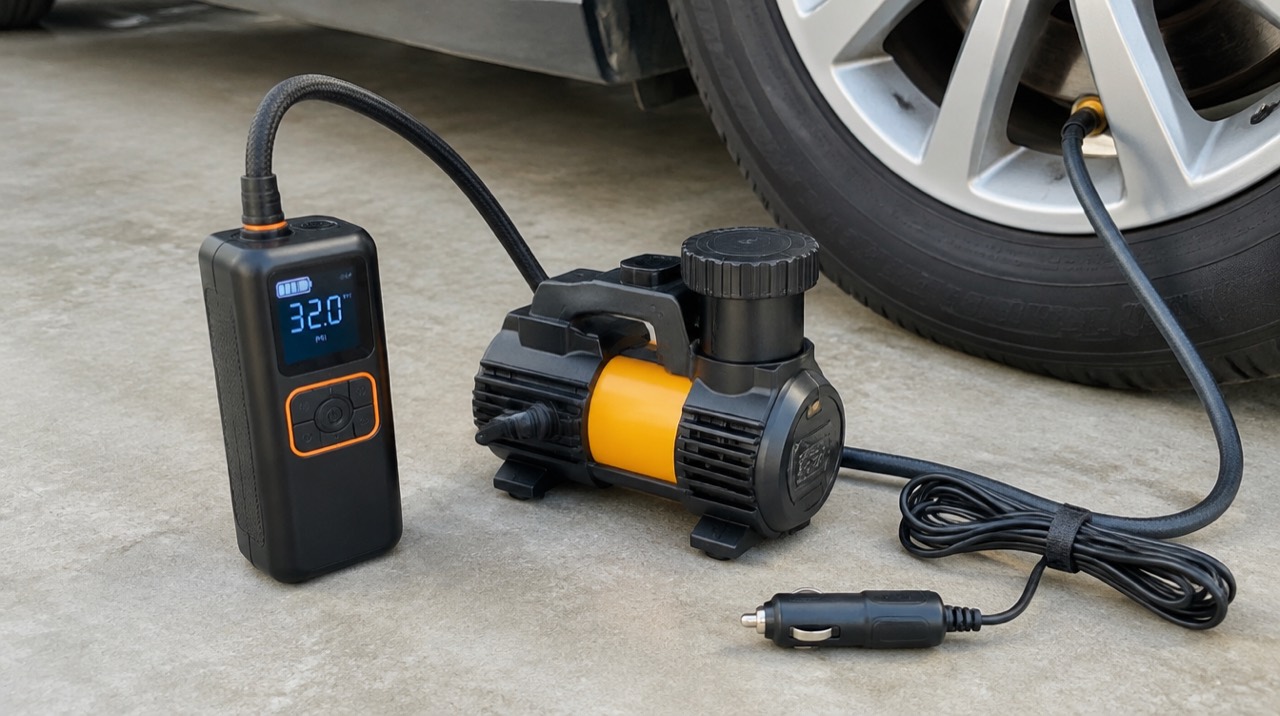
Cordless inflators run from a built-in lithium battery (or a power-tool battery) and charge over USB-C or a dock. They are designed for short runs: a few PSI into each tire, then back in the bag.
12V inflators draw power from the vehicle. Small ones plug into the accessory socket; bigger ones clip to the battery terminals, because accessory sockets are fused. Honda’s owner’s manual, for example, rates its accessory socket at 180 watts (15 amps) or less. AstroAI’s socket-plug AIRUN H lists 120W and a 15A fused plug; VIAIR’s 88P draws 20 amps and clips to the battery for that reason.
Specs compared
| Model | Type | Airflow (maker) | Max PSI | Run limit (maker) | Capacity per charge (maker) |
|---|---|---|---|---|---|
WOLFBOX MegaFlow24 $59.99Price as of November 15, 2026, 5:39 PM ET. Prices and availability are accurate as of the date/time indicated and are subject to change. Any price and availability information displayed on Amazon.com at the time of purchase will apply to the purchase of this product. | Cordless + 12V cord | 35 L/min | 150 | not stated | up to 24 sedan tires, 29→36 PSI |
Birtokom T06 $49.99Price as of November 15, 2026, 5:39 PM ET. Prices and availability are accurate as of the date/time indicated and are subject to change. Any price and availability information displayed on Amazon.com at the time of purchase will apply to the purchase of this product. | Cordless | 35 L/min | 150 | not stated | up to 4 flat tires |
AstroAI L7 $21.83Price as of November 15, 2026, 5:39 PM ET. Prices and availability are accurate as of the date/time indicated and are subject to change. Any price and availability information displayed on Amazon.com at the time of purchase will apply to the purchase of this product. | Cordless | not stated | 150 | rest 10 min after 15 min | up to 8 tires, 30→36 PSI |
AstroAI AIRUN H $30.39Price as of November 15, 2026, 5:39 PM ET. Prices and availability are accurate as of the date/time indicated and are subject to change. Any price and availability information displayed on Amazon.com at the time of purchase will apply to the purchase of this product. | 12V socket plug | 35 L/min | not compared | auto-off at 15 min, 10 min cool-down | unlimited while the car supplies power |
| VIAIR 88P | 12V battery clamps | 1.97 CFM (about 56 L/min) at 0 PSI | 120 | 25 min at 30 PSI | unlimited while the car supplies power |
| VIAIR 300P | 12V battery clamps | 2.30 CFM (about 65 L/min) at 0 PSI | 150 | 33% at 100 PSI | unlimited while the car supplies power |
VIAIR is linked to its own spec pages; check the current price on Amazon for the others. Fill times in listings use different tire sizes and start and end pressures, so compare them loosely. Only VIAIR states that its airflow is measured at 0 PSI.
Three things stand out. First, airflow at the small end is a wash: 35 L/min shows up on both cordless and plug-in models. Second, the battery-clamp VIAIRs list meaningfully more airflow and much longer run times, which is what you need for a 33-inch tire. Third, cordless makers rarely publish a duty cycle; the “per charge” claim is the closest proxy.
Where cordless wins
Convenience. No cord to route through a window, no engine idling in a garage, no fuse to worry about. That is why people actually check their tires with them.
Size and weight. WOLFBOX’s HyperFlow19 is listed at 1 lb, and AstroAI’s L7 at under 1 lb. A VIAIR 88P is 4.75 lb with a hose and clamps.
Versatility. Presets for bikes, motorcycles and balls, plus Presta adapters, are standard. Several double as USB power banks.
Top-ups. Adding 3 to 5 PSI to four car tires is well within every cordless model’s per-charge claim.
Where 12V wins
Big tires and big fills. WOLFBOX says the MegaFlow24 is “not suitable for RVs, pickup trucks, or large SUVs,” and AstroAI says the L7 is not for tires larger than 25 inches. VIAIR says the 300P can inflate tires up to 33 inches. If you drive on LT tires, start with tire inflators for truck tires.
Run time. A 12V unit never “runs out” while the vehicle supplies power, only overheats. VIAIR’s 88P lists 25 minutes at 30 PSI; AstroAI’s plug-in AIRUN H shuts off at 15 minutes and needs 10 to cool.
Cold weather. Lithium cells lose capacity in the cold and should not be charged below 32°F, per Battery University. VIAIR lists the 88P for ambient temperatures down to -4°F. More in cordless tire inflators in cold weather.
No charging discipline. A cordless inflator left flat in the trunk does nothing. A 12V unit works as long as the car does.
Speed in practice: top-up vs flat
The fill-time claims on listings almost all describe a top-up: WOLFBOX’s 29 to 36 PSI in 60 seconds on a 195/65R15, AstroAI’s 30 to 36 PSI in about 1.5 minutes. A top-up adds a few PSI to air that is already in the tire. A flat tire is a different job: the inflator has to supply the tire’s whole volume, and airflow falls as pressure rises. That is where the per-charge numbers shrink fast. WOLFBOX claims up to 24 sedan top-ups per charge on the MegaFlow24, while Birtokom states its T06 figure as up to four flat tires.
So the honest speed comparison is:
- Weekly or monthly top-ups on a car: cordless and plug-in 12V units are roughly equal on paper, and cordless is faster in real life because you skip running a cord and starting the engine.
- One flat car tire after a plug repair: most cordless units can do it on a full charge; a 12V unit does it without worrying about charge. See how to plug a tire and reinflate.
- Four large tires from 15 PSI after off-roading: a battery-clamp 12V compressor with a published duty cycle, every time.
Running costs and upkeep
Neither type needs much. A cordless inflator’s lithium battery is a wear item: it should be stored partly charged, topped up every few months, and kept out of a hot dashboard in summer. A 12V compressor has no battery to age, but its cord, clamps and fuse are failure points, and running it with the engine off can drain a weak car battery. Check your compressor’s manual on whether to run the engine during long fills, and keep a spare fuse of the right rating in the car.
Featured cordless options
These brands pay a bonus commission through Creator Connections. They fit the cordless use case above; none is a substitute for a battery-clamp compressor on truck tires.
Featured (disclosed relationship)
WOLFBOX MegaFlow24 cordless inflator. 35 L/min and 150 PSI, three 4,000 mAh cells, a claimed 24 sedan top-ups (29 to 36 PSI) per charge, a -4°F to 122°F range and a 24-month warranty per the listing. It also has an 11-ft 12V cord, so it can keep running when the battery is low, the best of both types for car owners.
Not for: RVs, pickups or large SUVs (WOLFBOX’s own exclusion), or buyers who want a charger in the box (not included).
Featured (disclosed relationship)
Birtokom T06 cordless inflator. 35 L/min, 150 PSI, a 6,000 mAh battery and a full-metal cylinder per the listing, with a claimed 28 to 36 PSI fill on a 195/65R15 tire in under a minute. Its per-charge claim is stated as up to four flat tires, a more useful number than top-up counts.
Not for: truck or RV tires, or anyone who needs a published duty cycle or a 12V backup cord.
Other cordless picks, including the compact WOLFBOX HyperFlow19 and the Smartour preset-and-stop unit, are compared in best cordless tire inflator, and both types side by side in best tire inflator.
Accuracy is the same problem either way
Both types use a built-in digital gauge, typically advertised at ±1 PSI. Those are maker claims, not independent tests. Check against a separate gauge occasionally, and always set pressure to the vehicle placard, not the tire sidewall; FuelEconomy.gov says not to use the maximum printed on the sidewall. The full procedure is in how to check tire pressure.
Mistakes to avoid
- Buying cordless for a three-quarter-ton truck. Read the maker’s tire-size limit before you buy.
- Plugging a high-draw compressor into a 15A socket. If it is rated above your socket, use a battery-clamp model.
- Running past the duty cycle. Overheating shortens compressor life; rest it as the manual says.
- Leaving a cordless unit uncharged for months. Top it up with your jump pack on the same schedule.
- Comparing fill times across brands. Different tires and pressures make the numbers apples to oranges.
Bottom line
- Cars and crossovers, monthly top-ups: cordless.
- Pickups on LT tires, RVs, off-road air-downs: 12V battery-clamp compressor.
- Want both: dual-power cordless with a 12V cord.
Pick the type for your biggest tire, then check the current price on Amazon.
Frequently asked questions
Is a cordless or 12V tire inflator better?
For topping up car tires a few PSI at a time, cordless is more convenient: no cord, no engine running, often under a pound and a half. For large truck, RV or off-road tires, or for filling a flat from near zero, a 12V compressor wins because it runs as long as the vehicle supplies power and the larger models publish duty cycles in the tens of minutes.
Are cordless tire inflators as fast as 12V ones?
At the small end, the published numbers are similar. The WOLFBOX MegaFlow24 cordless and the AstroAI AIRUN H 12V both list 35 L/min. The difference shows up on long fills: battery models run down and many have rest limits, while a battery-clamp 12V compressor like the VIAIR 88P lists 25 minutes of run time at 30 PSI.
How many tires can a cordless inflator fill per charge?
Maker claims vary with tire size and how much air you add. WOLFBOX claims up to 24 sedan tires from 29 to 36 PSI on the MegaFlow24, AstroAI up to 8 tires from 30 to 36 PSI on the L7, and Birtokom up to four flat tires on the T06. A flat tire uses far more than a top-up.
Can a 12V tire inflator blow a fuse?
Yes if it draws more than the socket is rated for. Owner's manuals commonly rate accessory sockets around 180 watts (15 amps) or less, and some lower. Larger compressors clip straight to the battery for that reason.
What is duty cycle on a tire inflator?
How long it can run before it must rest to cool, stated as minutes or a percentage at a given pressure. AstroAI's AIRUN H shuts off after 15 minutes of continuous running and needs 10 minutes to cool; the AstroAI L7 cordless says to rest 10 minutes after 15 minutes.
Keep planning
- Best Black Friday Jump Starter Deals 2026: Timing and What to Buy
The best jump starter Black Friday deals in 2026, with guidance on which specs matter, which brands discount and how to avoid buying undersized packs.
Updated Nov 2026 - Best Portable Jump Starter for Cars, Trucks and Diesels (Spec Picks)
The best portable jump starter for your engine and fuel: spec-based picks from NOCO, GOOLOO, ETENWOLF and VACASSO, sized for cars, V8 trucks, diesels and winter.
Updated Nov 2026 - Jump Starter Gift Guide 2026: Picks for Every Driver on Your List
Holiday gift guide for jump starters and tire inflators, grouped by who it is for: teen drivers, cold commuters, truck owners, road-trippers and gadget fans.
Updated Oct 2026