How Long Does a Jump Starter Hold a Charge?
In this guide
A charged lithium jump starter usually holds enough charge to start a car for several months, but manufacturers ask you to recharge it every 2 to 6 months, most often every 3. Heat shortens that window, a pack left in a summer car drains and ages faster, and a pack that drops below about half charge may not have enough left to crank a big engine. The safe habit is simple: recharge on the manual’s schedule, after every jump, and before any long trip. This guide is built from battery-chemistry data, manufacturer manuals and Amazon listings checked on 2026-10-28.
Disclosure: As an Amazon Associate I earn from qualifying purchases. Some brands featured below pay a bonus commission through Amazon Creator Connections. See /disclosure/.
What makers actually say
Jump starter listings rarely say “holds a charge for X months” in a testable way. What they do give is a recharge interval, which is the number that matters. These are from the Amazon listings we read on 2026-10-28:
| Pack | Maker’s recharge interval in storage | Other storage note |
|---|---|---|
GOOLOO GP4000 $79.99Price as of November 15, 2026, 5:39 PM ET. Prices and availability are accurate as of the date/time indicated and are subject to change. Any price and availability information displayed on Amazon.com at the time of purchase will apply to the purchase of this product. | Every 2 to 3 months | Wall charger not included |
GOOLOO GP3000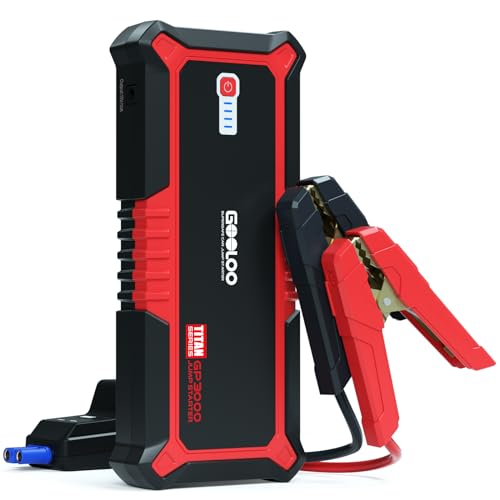 $59.99Price as of November 15, 2026, 5:39 PM ET. Prices and availability are accurate as of the date/time indicated and are subject to change. Any price and availability information displayed on Amazon.com at the time of purchase will apply to the purchase of this product. | Every 90 days | |
GOOLOO A3 $69.99Price as of November 15, 2026, 5:39 PM ET. Prices and availability are accurate as of the date/time indicated and are subject to change. Any price and availability information displayed on Amazon.com at the time of purchase will apply to the purchase of this product. (with compressor) | Every 3 months | Charge only between 14°F and 113°F |
| Giroago 6000ACheck price on Amazon | Every 2 to 3 months | Start the car when the pack is above 75% |
HDJFLU HD09 $179.95Price as of November 15, 2026, 5:39 PM ET. Prices and availability are accurate as of the date/time indicated and are subject to change. Any price and availability information displayed on Amazon.com at the time of purchase will apply to the purchase of this product. | Every 3 months | |
Odifni 8-in-1 $69.99Price as of November 15, 2026, 5:39 PM ET. Prices and availability are accurate as of the date/time indicated and are subject to change. Any price and availability information displayed on Amazon.com at the time of purchase will apply to the purchase of this product. | Every 3 months | Keep above 30% to jump |
VACASSO Z08 $48.39Price as of November 15, 2026, 5:39 PM ET. Prices and availability are accurate as of the date/time indicated and are subject to change. Any price and availability information displayed on Amazon.com at the time of purchase will apply to the purchase of this product. | Every 3 to 6 months (description also says 2 to 3) | Listing claims standby up to 24 months |
AstroAI S8 $42.19Price as of November 15, 2026, 5:39 PM ET. Prices and availability are accurate as of the date/time indicated and are subject to change. Any price and availability information displayed on Amazon.com at the time of purchase will apply to the purchase of this product. | Store at about 60% if unused over 3 months | Not in hot trunks |
The pattern is clear: three months is the consensus, and where a listing gives two numbers, the shorter one is the safe one. A “standby up to 24 months” claim means the pack will still hold some charge after two years at mild temperatures, not that it will still start your truck.
Why a pack loses charge
Self-discharge
Every battery slowly discharges itself. Battery University puts lithium-ion cell loss at about 5 percent in the first 24 hours after charging, then 1 to 2 percent per month, with the protection circuit adding roughly another 3 percent per month (Battery University BU-802b). A jump starter is not just bare cells: it has a battery-management circuit, a charge display and often a standby microcontroller, so treat a few percent per month at room temperature as a realistic floor.
Heat
Temperature is the multiplier. Battery University notes that self-discharge for all chemistries typically doubles with every 10°C (18°F) rise. Its table for lithium-ion stored at 40 to 60 percent charge shows about 2 percent per month at 0°C, 4 percent at 25°C and 15 percent at 60°C. A car parked in the sun can reach that upper range: NOCO warns that a closed car can hit 122°F (50°C) within about 10 minutes. Heat also ages the cells permanently, so a pack that spends summers on the dashboard loses capacity it will never get back. Lithium jump starter safety covers safe storage temperatures.
Cold
Cold slows self-discharge, which is good for storage, but it also cuts how much current the pack can deliver right now. A pack that reads full in a frozen car may still struggle to crank. Bring it inside to warm up if you can, and see jump starters in cold weather for the details.
Use
Each jump uses a modest share of a healthy pack’s energy, and each phone charge or flashlight session takes more. A jump uses less than you might expect, but several failed crank attempts in a row can take a lot. Makers’ “starts per charge” figures (35 for the ETENWOLF J1, up to 50 for the VACASSO Z08) are best-case claims; how many jump starts per charge explains why real numbers are lower.
How much charge you need to start the car
A pack that is “not dead” is not necessarily ready. Makers set their own floors:
- Topdon V3000 manual: use only when the battery level is above 50 percent.
- Odifni listing: keep the battery above 30 percent for jump starting.
- Giroago listing: start the car when the pack is above 75 percent.
Most packs show charge as four lights in 25 percent steps (NOCO’s GB40 guide describes 25, 50, 75 and 100 percent LEDs). A practical rule: two lights is the minimum before you rely on it, and anything less means recharge first. Bigger engines, diesels and cold mornings need more.
A storage routine that works
- Charge fully when new. NOCO’s GB40 guide and Topdon’s V3000 manual both say the pack ships partially charged and must be fully charged before first use.
- Set a calendar reminder at the maker’s interval, or every 3 months if you are unsure. Move it to every 2 months in summer if the pack lives in the car.
- Store it out of the sun. Trunk or under a seat beats the glove box and dashboard. Bring it indoors during heat waves.
- Recharge after every jump and after heavy USB use, as soon as you are home.
- Charge within the charging temperature range, often about 32°F to 104°F. Let a cold pack warm up first.
- Check it before road trips and the first cold snap. Press the power button and read the lights.
- For long layups (more than 3 months unused, not in the car), some makers suggest about 60 percent charge, as AstroAI’s listing does. Top it up to full before it goes back in the vehicle.
Lithium vs lead-acid vs supercapacitor
| Type | How long charge lasts in storage | Maintenance |
|---|---|---|
| Lithium pack | Months; recharge every 2 to 6 months per makers | Calendar top-ups; avoid heat |
| Sealed lead-acid jump box | Shorter; Clore’s older Jump-N-Carry manual asks for a recharge every 3 months in winter and monthly in summer | Many are designed to stay plugged in |
| Supercapacitor booster | Not designed to hold charge; charges at the scene | None in storage |
Lead-acid boxes like the Clore Jump-N-Carry are heavy but sturdy, and Clore says its JNC660 has automatic recharging so it can stay plugged in. Supercapacitor boosters dodge the storage problem entirely by charging from your weak battery or another car at the moment of use; GYS says its GYSCAP stays operational “even after years in storage” (GYS spec sheet). The trade-offs are in supercapacitor vs lithium jump starter.
Packs with clear storage guidance
If you are buying, prefer a pack whose listing states an operating range and a recharge interval, and whose charge display is easy to read.
Featured (disclosed relationship)
VACASSO Z08 5000A jump starter. Rated for 10L gas and 8L diesel, a 59.2Wh battery, an LED status display, a stated -4°F to 140°F operating range and a hard case. Its listing claims standby of up to 24 months and asks for a full charge every 3 to 6 months (another part of the listing says 2 to 3); plan on the shorter interval.
Not for: buyers who want the smallest pack or a maintenance-free unit.
Featured (disclosed relationship)
ETENWOLF J1 2000A jump starter. Rated for 8.0L gas and 6.5L diesel, up to 35 starts per charge, a stated -4°F to 140°F operating range and a 2-hour recharge. A quick recharge makes the top-up habit painless.

Not for: large diesel trucks, or anyone who wants a recharge interval spelled out in the listing (we did not find one in the text we read; follow the manual).
For more choices across brands, see the best portable jump starter roundup. Check the current price on Amazon.
Signs your pack no longer holds a charge
- It drops from full to two lights within a few weeks of sitting.
- It shows full but clicks or fails on an engine it used to start.
- It takes far longer to charge than when new, or never reaches full.
- The case is swollen, gets hot while idle, or smells. Stop using it and dispose of it as hazardous waste.
If it will not charge at all after sitting flat for a long time, some packs’ protection circuits lock out a deeply discharged battery. Check the manual’s troubleshooting section before assuming it is dead, and see jump starter not working.
Bottom line
Assume three months. Recharge every 3 months (every 2 in a hot car), after every jump and before long trips, keep the pack out of direct sun, and treat two of four charge lights as the minimum before you rely on it. A pack maintained that way is ready when the battery is not.
Frequently asked questions
How long will a fully charged jump starter last unused?
A lithium pack typically keeps enough charge to start a car for several months, but makers set recharge intervals of every 2 to 3 months (GOOLOO GP4000, Giroago) to every 3 months (HDJFLU, Odifni), and one listing (VACASSO) says every 3 to 6 months. Follow your manual's interval, and shorten it if the pack lives in a hot car.
Why does my jump starter lose charge sitting in the car?
All batteries self-discharge, and lithium packs also power a protection circuit and charge indicator. Battery University puts lithium-ion cell loss at 1 to 2 percent per month plus about 3 percent per month for the protection circuit, and the rate roughly doubles for every 10°C (18°F) rise in temperature.
Should I store a jump starter fully charged?
For a pack you rely on, yes, keep it charged so it works when you need it, and recharge on the maker's schedule. AstroAI's listing suggests storing at about 60 percent if the pack will go unused for more than three months, a common lithium storage practice; top it up before you put it back in the car.
What charge level do I need to jump a car?
More than you might think. Odifni's listing says to keep the battery above 30 percent for jump starting, Topdon's V3000 manual says to use it only above 50 percent, and Giroago's listing recommends starting the car when the pack is above 75 percent. Treat two of four indicator lights as the minimum and recharge after every jump.
Do lead-acid jump boxes hold a charge longer?
No. Sealed lead-acid jump boxes self-discharge faster than lithium and are harmed by sitting discharged. An older Clore Jump-N-Carry manual asks for a 24-hour recharge at least every three months in winter and monthly in summer, and newer models are designed to stay plugged in.
Keep planning
- What Size Jump Starter Do I Need? Amps by Engine and Climate
What size jump starter do you need? Match the maker's gas or diesel engine rating to your displacement, then size up for cold climates. Tables and examples inside.
Updated Nov 2026 - How to Use a Jump Starter: Step-by-Step Instructions
How to use a jump starter or jump box, step by step: clamp order, how long to crank, rest between tries, boost mode and lithium safety, from the manuals.
Updated Nov 2026 - Do Jump Starters Work in Cold Weather? Winter Tips for Lithium Packs
Do lithium jump starters work in cold weather? Yes, within limits: operating vs charging temperatures, sizing up for winter, storage and a pre-freeze checklist.
Updated Nov 2026