Car Won't Start After a Jump? Battery, Alternator or Starter
In this guide
- Start here: what do you hear?
- Case 1: rapid clicking
- Case 2: one click, or nothing, with bright lights
- Case 3: it cranks normally but won’t fire
- Case 4: it started, then died
- Case 5: it starts, but needs a jump again the next day
- Reading battery voltage
- When to stop and call for help
- What to keep in the car
- Bottom line
If your car will not start even with a jump, the sound it makes tells you most of what you need to know. Rapid clicking means not enough current is reaching the starter, usually a weak connection, a weak pack or a very flat battery. A single click or silence with bright dash lights points to the starter or its wiring. Normal cranking without firing is not a battery problem at all. And a car that starts, then dies a few minutes later, usually has a charging problem. This guide walks through each case using AAA, battery-maker and jump-pack manual guidance read on 2026-10-28, and tells you when to stop trying and call for help.
Disclosure: As an Amazon Associate I earn from qualifying purchases. Some brands featured below pay a bonus commission through Amazon Creator Connections. The BlueDriver link below goes through Levanta, a partner program. See /disclosure/.
Start here: what do you hear?
| What happens when you turn the key or press start | Most likely cause | First thing to check |
|---|---|---|
| Rapid clicking, dash lights dim or flicker | Not enough current reaching the starter | Clamp contact, pack charge, pack size; let the battery take a charge |
| One loud click, lights stay bright | Starter motor, starter relay or solenoid, or its wiring | Battery cable connections at the starter; get it diagnosed |
| Nothing at all, no lights | Very flat battery, loose or corroded main terminal, or pack not detecting the battery | Terminal clamps, then boost or override per your pack manual |
| Slow, labored cranking that never catches | Pack too small or low, or the battery is dragging it down; very cold oil | Rest and recharge the pack, try a bigger pack |
| Normal-speed cranking, engine won’t fire | Fuel, ignition, immobilizer or flooding; not the battery | Stop jumping; check for a security light or fuel issue |
| Starts, then dies within minutes | Charging system (alternator, belt, wiring) or a battery that cannot hold charge | Have the battery and alternator tested |
| Starts fine, dead again next morning | Worn battery, parasitic drain, or not recharged after the jump | Charge fully, then load-test the battery |
Common causes for each symptom, not a diagnosis. A shop or parts store test confirms which part has failed.
Case 1: rapid clicking
The clicking is the starter solenoid engaging and dropping out because voltage collapses as soon as the motor draws current. With a jump connected, that means the jump is not delivering enough.
Check, in this order:
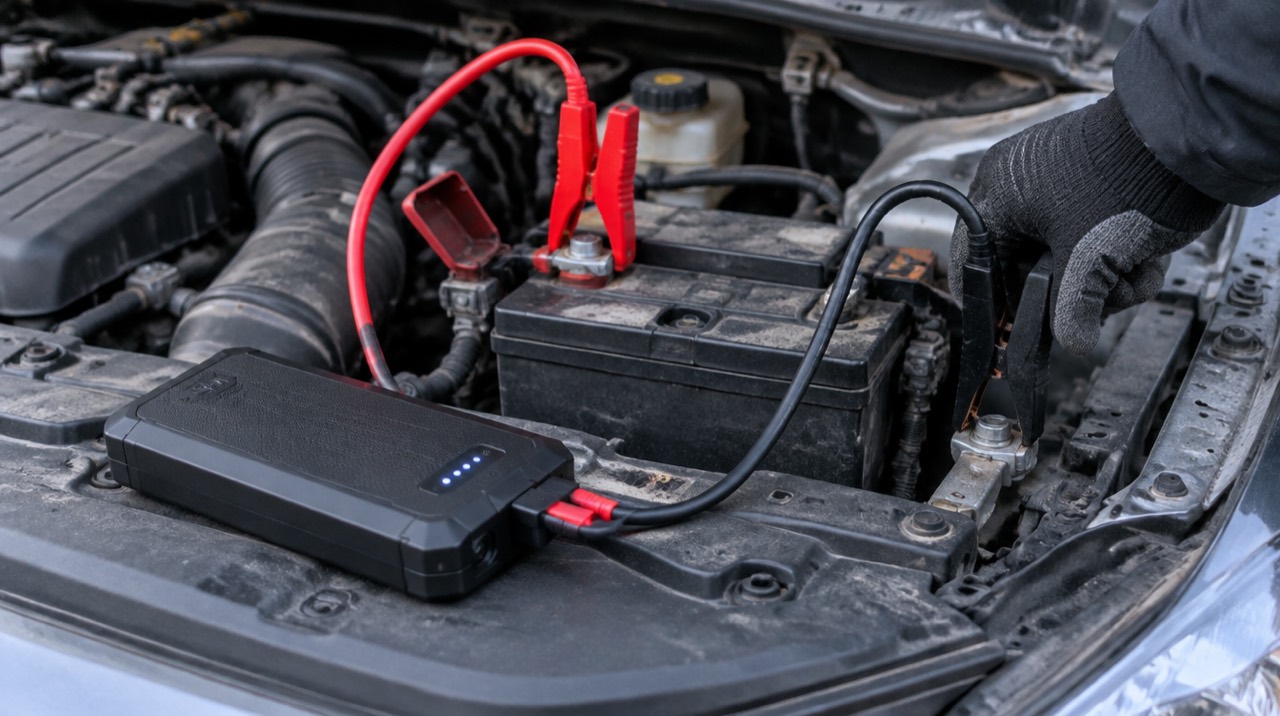
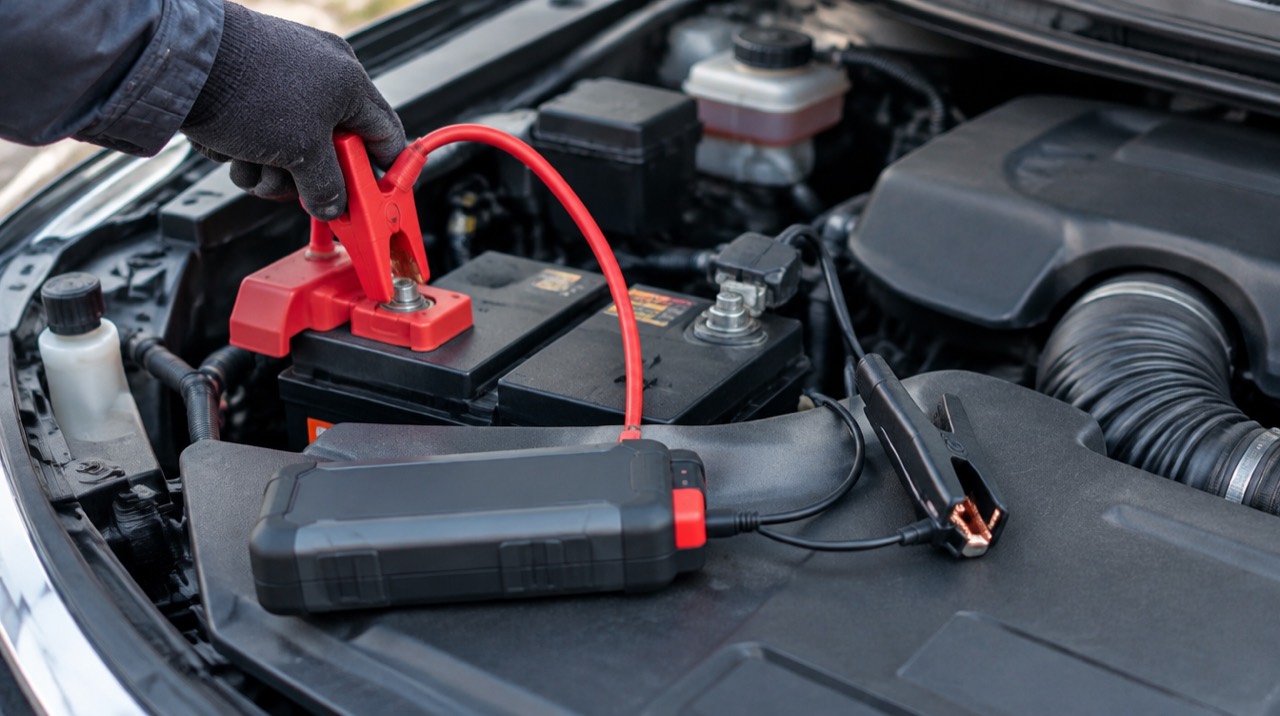
- The clamps. Each jaw must bite clean, bare metal. Battery terminals often have a crust of white or green corrosion; side-post terminals and plastic covers are easy to clamp badly. Wiggle the clamps until they bite, or move the black clamp to a bare engine ground.
- The pack’s charge. A pack that has sat in the trunk for months may be too low. Check its indicator. How long a jump starter holds a charge has maker recharge intervals.
- Give it time. NOCO’s GB40 guide says some vehicles need the pack connected for up to 30 seconds before they will start. With jumper cables, AAA has you leave the donor running and connected for a few minutes.
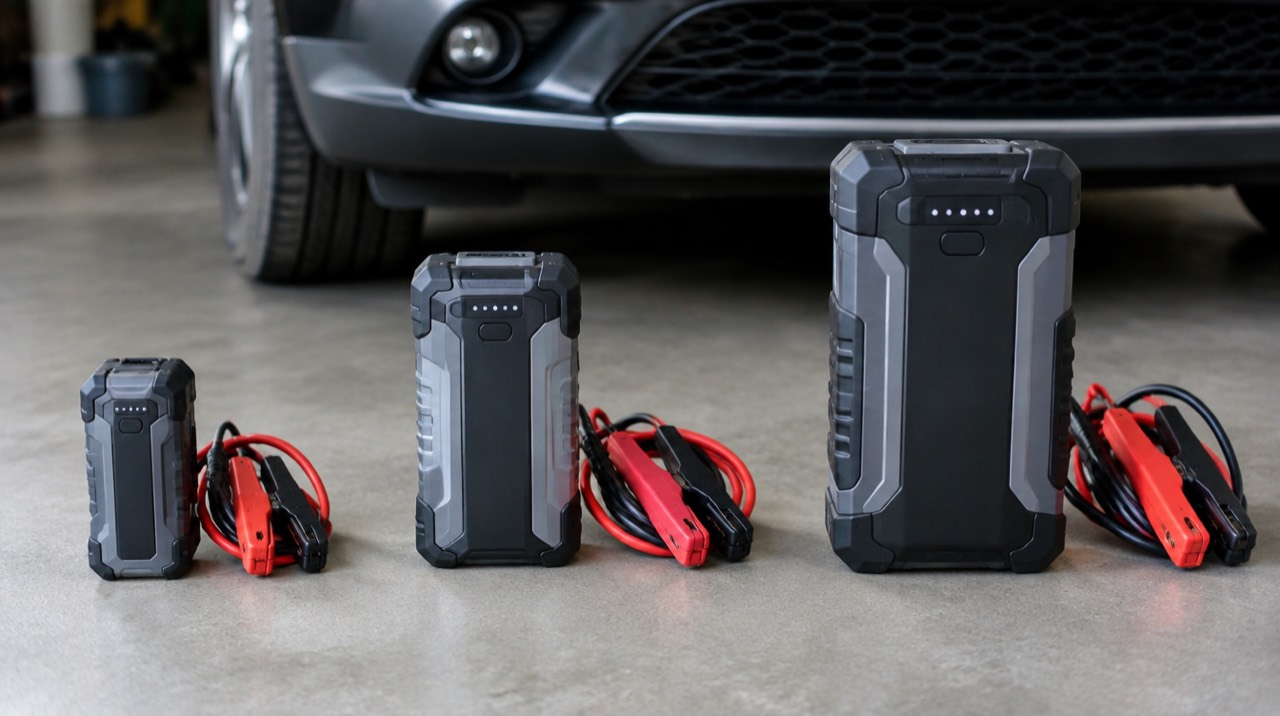
- The pack’s size. A small pack on a big V8 or diesel, especially in cold weather, may not be enough. See what size jump starter do I need.
- The main battery cables. If the clamps are on the battery posts but the car’s own cable ends are loose or corroded, current never reaches the starter. Clamping directly onto the cable ends or a remote jump terminal can help; see where to connect a jump starter.
Case 2: one click, or nothing, with bright lights
If the dash and headlights are bright but the engine does nothing except a single click, the battery is probably delivering power and the problem is further along: the starter motor, its solenoid or relay, a neutral safety switch (try starting in Neutral on an automatic, per your manual), or a bad cable at the starter. A jump will not fix any of these. Stop and get it diagnosed or towed.
If there are no lights at all, the battery is either extremely flat or disconnected by a loose terminal. Many lithium packs will not output until they detect a battery; NOCO’s GB40 Boost LED stays off below 2 volts. That is what boost or manual override is for, used exactly as your pack’s manual says. Override disables the pack’s reverse-polarity protection, so check polarity twice. How to use a jump starter covers the modes by brand, and jump starter not working covers pack error lights.
Case 3: it cranks normally but won’t fire
If the engine spins over at its normal speed, your battery problem is solved; something else is stopping it running. Common candidates:
- Immobilizer or security light flashing on the dash (key fob battery, unrecognized key).
- Fuel: an empty tank, a failed fuel pump (listen for a brief hum when you switch on), or a flooded engine after many attempts.
- Ignition or sensor faults, which need a scan tool.
Ignition and sensor faults are the ones a scan tool can name. The BlueDriver is a Bluetooth OBD2 scanner that plugs into the port under the dash and pairs with a phone. BlueDriver’s product page (read 2026-11-26) says the app has no subscription fee, and that on supported vehicles it reads ABS, airbag (SRS) and TPMS codes as well as check-engine codes. Those extra systems are not available on every year and make, so confirm coverage for your car. A scanner will not tell you whether the battery or the alternator is healthy; that is still the voltage check below, or a load test at a parts store. OBD Scanner Guide compares scanners if you want to look at the category.
Repeated cranking here only overheats the starter and drains the pack. NOCO’s guide caps attempts at five in 15 minutes before a 15-minute rest. Stop and get help.
Case 4: it started, then died
This is the classic alternator symptom. AAA’s jump-start guidance says that if a car starts with a jump but dies again after a short drive, the alternator is likely not recharging the battery. Look for a battery or charging warning light on the dash, dimming lights, or a squealing or broken drive belt.
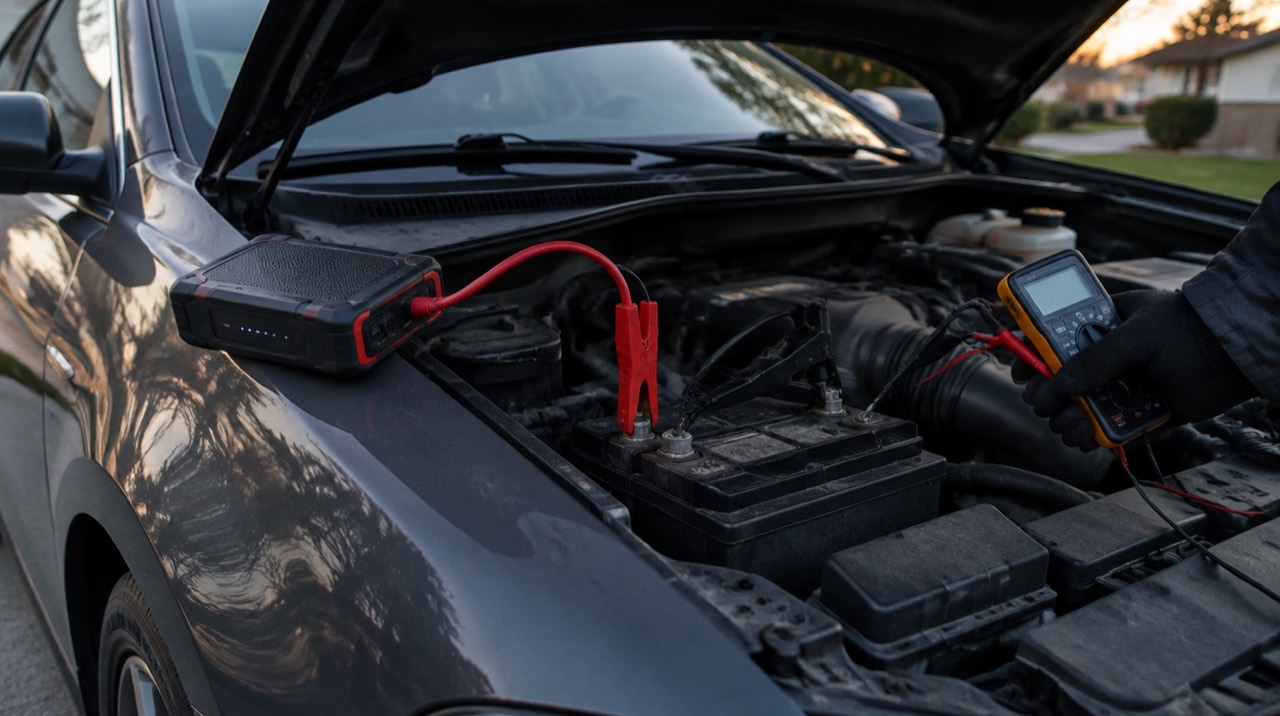
It can also be a battery so worn that it collapses the moment the pack is removed. The only way to know is to test both. If you have a multimeter, measure across the battery terminals with the engine running: many cars read roughly 13.5 to 14.5 volts when charging, and a reading near or below the resting voltage suggests the alternator is not charging. Your service manual has the exact specification. Most auto parts stores and repair shops can test the battery and charging system together.
Case 5: it starts, but needs a jump again the next day
A jump does not recharge the battery, and a short drive may not either. AAA suggests at least 20 to 30 minutes of continuous driving with the A/C and rear defroster off. Battery maker OPTIMA says alternators are designed to maintain near-full batteries and that a deeply discharged battery should go on a dedicated charger. Can a jump starter charge a dead battery? explains why the pack itself cannot.
If the battery is fully charged and still goes flat overnight, either it can no longer hold a charge (AAA notes batteries over about three years old often cannot) or something is draining it with the car off, such as a glove-box or trunk light, an aftermarket accessory, or a module that will not sleep. A load test separates the two.
Reading battery voltage
A multimeter costs little and answers the first question quickly. Measure with the engine off after the car has sat for a few hours:
| Resting voltage (typical flooded 12V battery) | Meaning |
|---|---|
| About 12.6V or more | Charged; if the car still won’t crank, look at connections or the starter |
| About 12.4V | Partly charged (Interstate’s guide pegs 12.42V at about 70 percent) |
| About 12.0V to 12.2V | Low; charge before judging it |
| Below about 12V | Deeply discharged; charge fully, then load-test |
Approximate; AGM and other battery types differ. OPTIMA lists 12.6 to 12.8V for a full REDTOP. Voltage shows charge, not health: a worn battery can read 12.6V and still fail under load.
When to stop and call for help
- After the number of attempts your pack’s manual allows.
- If the battery case is cracked, bulging or leaking, or smells of rotten eggs.
- If you smell burning or see smoke from the starter area.
- If the car is a hybrid or EV and the normal 12V procedure in its manual does not work. See how to jump-start an electric car.
What to keep in the car
A pack with enough headroom for your engine and climate, a cheap multimeter or handheld 12V battery tester, and, at home, a plug-in charger for after the jump. When the engine cranks and still will not fire, a Bluetooth OBD2 scanner such as the BlueDriver reads codes a meter cannot. It is not a battery tester.
Featured (disclosed relationship)
ETENWOLF J1 2000A jump starter. Rated for gas engines up to 8.0L and diesels up to 6.5L, with a listed -4°F to 140°F operating range and IP65. ETENWOLF says it starts batteries down to 9V and claims up to 35 starts per charge (a maker figure). Plenty of headroom for most cars and small trucks, which removes “pack too small” from the diagnosis.

Not for: big diesel pickups beyond 6.5L, or 24V systems. It is a jump starter, not a tester; carry a meter for Case 4 and 5 problems.
Among non-featured options, the NOCO Boost X GBX45 (1,250A, rated to 6.5L gas and 4.0L diesel, 48-minute USB-C recharge per its listing) is a compact well-known alternative; its manual summary says it is designed for 12V lead-acid batteries down to 3 volts. For after the jump, a smart charger such as the NOCO GENIUS2 (2A, lead-acid and LiFePO4) recharges and maintains the battery. Check the current price on Amazon.


Bottom line
Listen before you swap parts. Rapid clicking is a current problem, so fix the connection, the pack’s charge or its size. One click with bright lights points at the starter. Normal cranking means the battery is fine. Starting then dying points at the alternator. Needing a jump every morning means the battery needs a full charge and a load test. When the pattern does not fit, stop cranking and get it tested.
Frequently asked questions
Why does my car click but not start after a jump?
Rapid clicking usually means the starter is not getting enough current: a pack or donor that is too weak or low, clamps biting on corrosion or paint, or a battery so flat it drags the voltage down. A single loud click with lights staying bright points more toward the starter or its wiring.
Car started with a jump, then died. Is it the alternator?
Often. AAA says a car that starts with a jump but dies again after a short drive suggests the alternator is not recharging the battery. A battery too worn to hold a charge can look similar, so have both the battery and charging system tested.
My engine cranks normally but won't fire. Is it the battery?
Probably not. If the engine spins at normal speed, the battery and starter are doing their job. Fuel, ignition, a security or immobilizer fault, or a flooded engine are more likely. Stop jumping and get it diagnosed rather than overheating the starter.
How many times can I try to jump-start?
Follow your pack's manual. NOCO's GB40 guide says to wait 20 to 30 seconds between attempts and make no more than five attempts in 15 minutes before resting the pack for 15 minutes. Repeated long cranking can overheat the starter.
Should I replace the battery if it needed a jump?
Not automatically. A battery drained by a light left on often recovers after a full charge. Replace it if a load test says it is weak, if it is several years old and keeps going flat, or if it is cracked, bulging or leaking. AAA notes batteries over about three years old may not hold a charge overnight.
Keep planning
- Jump Starter Not Working? Fixes for No Power, Lights, Clicks
Jump starter not working? Fix a pack that won't turn on, won't detect the battery, shows a red error light or only clicks, using maker manuals, step by step.
Updated Nov 2026 - What Size Jump Starter Do I Need? Amps by Engine and Climate
What size jump starter do you need? Match the maker's gas or diesel engine rating to your displacement, then size up for cold climates. Tables and examples inside.
Updated Nov 2026 - How to Use a Jump Starter: Step-by-Step Instructions
How to use a jump starter or jump box, step by step: clamp order, how long to crank, rest between tries, boost mode and lithium safety, from the manuals.
Updated Nov 2026