Can You Jump-Start an Electric Car? The 12V Battery Explained
In this guide
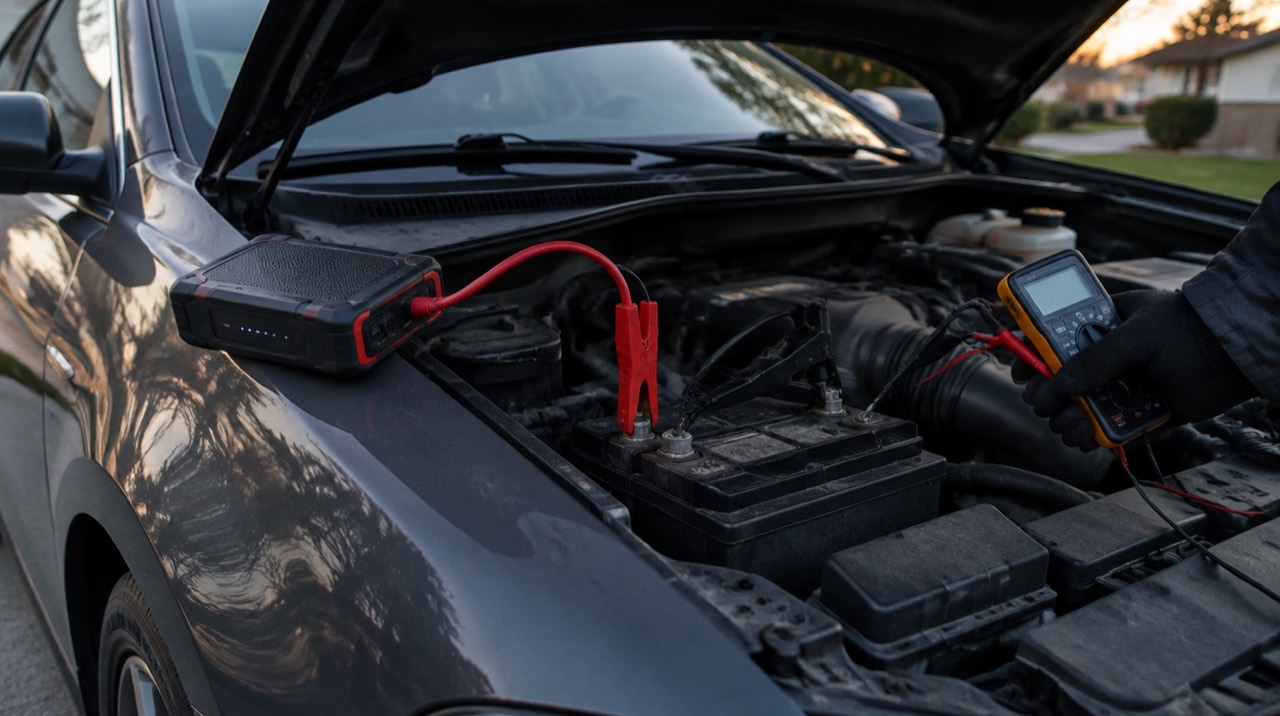
Yes, you can jump-start an electric car, but only its small low-voltage battery, usually called the 12V battery. You never jump the high-voltage drive battery, and a jump pack cannot add range. Tesla, Ford and Hyundai manuals all describe connecting an external 12V source, such as a portable jump starter, to dedicated low-voltage terminals, then keeping the car on so it can recharge itself. Tesla’s manuals also say its cars must not be used to jump another vehicle. This guide summarizes what those manuals say, read on 2026-10-28, and what to keep in the car. It is not a substitute for your own owner’s manual, which governs.
Disclosure: As an Amazon Associate I earn from qualifying purchases. Some brands featured below pay a bonus commission through Amazon Creator Connections. See /disclosure/.
Why an EV with a full battery can be completely dead
Every mainstream EV has two batteries:
| High-voltage (drive) battery | Low-voltage (12V) battery | |
|---|---|---|
| Job | Powers the motor, gives you range | Runs locks, screens, lights and the computers that switch the drive battery on |
| Voltage | Hundreds of volts | 12V on most cars (Cybertruck uses a 48V low-voltage system) |
| How it charges | At a charger | From the drive battery through a DC-DC converter while the car is on |
| Can you jump it? | Never | Yes, as your manual describes |
The DC-DC converter does the job an alternator does in a gas car: it steps the drive battery’s voltage down and keeps the 12V battery topped up, as Aptiv’s explainer puts it. The catch is that the converter only works once the car’s computers have woken up and switched the drive battery on, and those computers run on the 12V battery. A flat 12V battery therefore leaves the car unable to unlock, open the frunk or go into drive, even with 300 miles of range. Ford’s support page for the Mustang Mach-E describes exactly that: a drained 12V battery can make the car unresponsive or unable to unlock.
What the manuals say, brand by brand
Tesla
The Model 3 owner’s manual (the edition copied on ManualsLib) assumes you are using an external low-voltage power supply “such as a portable jump starter.” The steps are:
- Open the hood. If the car has no power, the manual’s “Opening the Hood with No Power” section explains how; it needs an external 12V supply too.
- Remove the maintenance panel and the cabin intake trim panel.
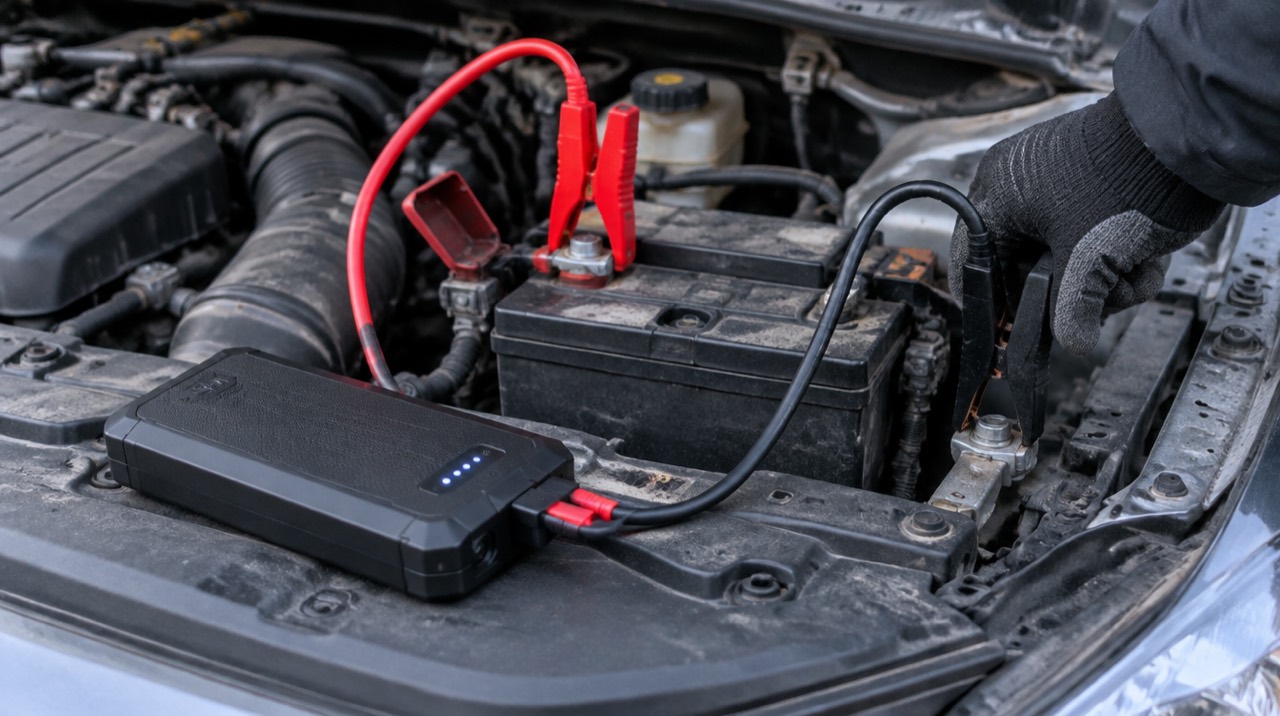
- Connect red (+) to the 12V battery’s positive terminal, keeping it away from other metal such as the battery tie-down bracket.
- Connect black (-) to the battery’s negative terminal.
- Turn on the supply and touch the touchscreen to wake it. It may take several minutes to get enough power.
- When finished, disconnect black first, then red, and refit the panels.
Newer editions of Tesla’s manual add that the procedure differs between cars with a lead-acid and a lithium-ion low-voltage battery, and tell you to check which one you have under Controls > Software > Additional Vehicle Information. The Model 3 and Model Y manuals both state the car cannot be used to jump start another vehicle and that doing so can cause damage.
Cybertruck is the outlier. Its jump-starting page says it uses a 48V low-voltage architecture. A 12V portable jump starter is acceptable, but some functions may be degraded below 30V; a variable supply should be set to 12 to 16.5V or 30 to 50V and not changed while connected. Tesla also says you may not be able to shift into Drive until the high-voltage battery charges and the low-voltage system recovers, and that Cybertruck cannot jump another vehicle either.
Ford Mustang Mach-E
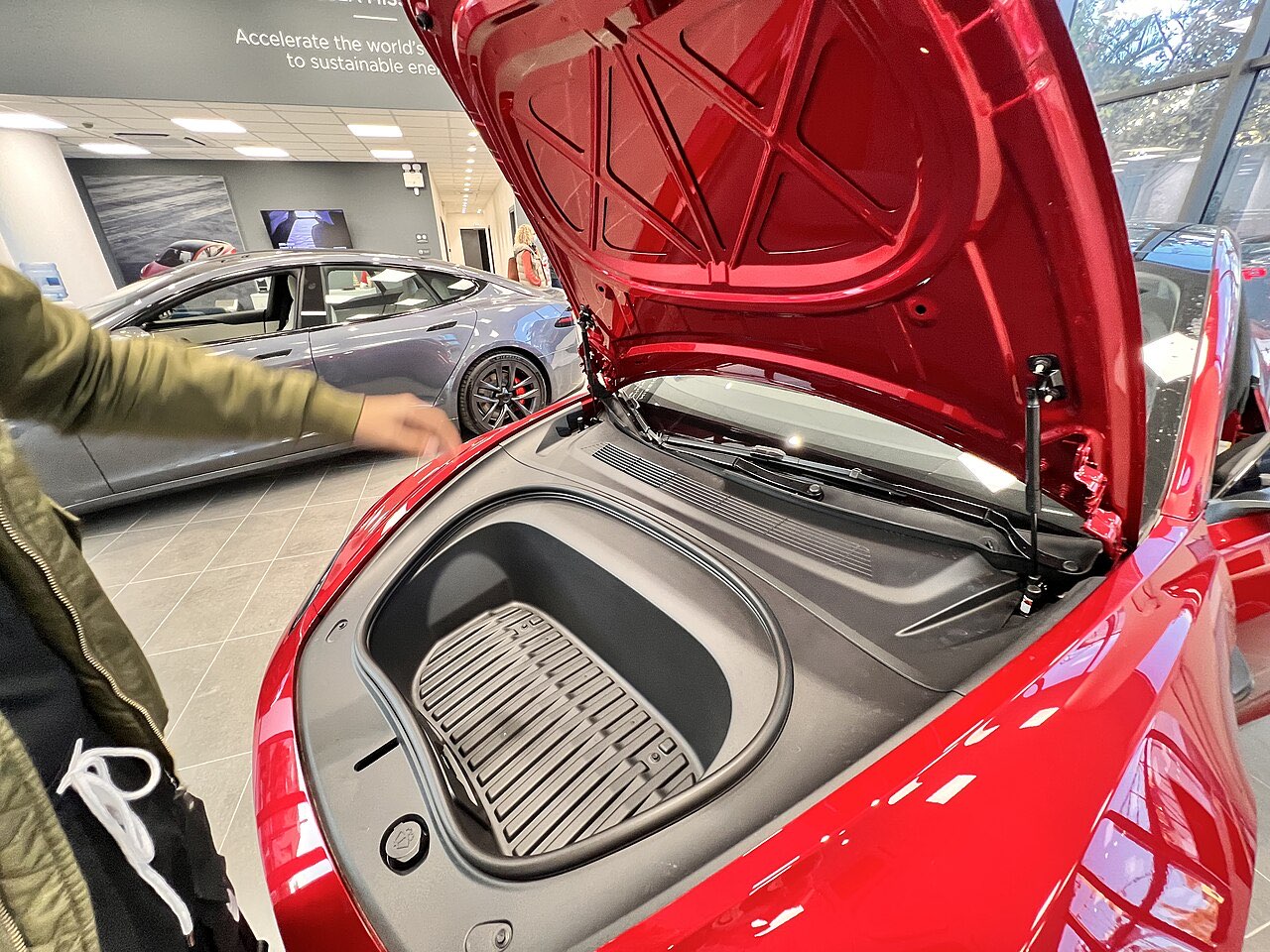
Ford’s frunk-with-no-power page describes a small cover on the front bumper below the headlight. Behind it are a red and a black wire. Connect a 12V jump box red to red and black to black and switch it on; the frunk latches should release at once. Then disconnect it and boost the 12V battery through the jump points under the frunk covers, as the owner’s manual’s “Jump Starting Your Vehicle” section shows. Ford’s unresponsive-vehicle page adds: press the brake and the start button, keep the source connected at least 3 minutes, do not turn on the headlamps while disconnecting, then drive to the nearest Ford dealer. Ford Roadside Assistance is 1-800-241-3673.
Hyundai
A 2025 Hyundai EV owner’s manual page (ownersmanual.hyundai.com) says to use only a 12V supply, remove the battery service cover in the front trunk and the motor-compartment fuse box cover, connect positive to the vehicle’s red jumper terminal and negative to a chassis ground point, not to the battery’s negative post. Keep the car on for at least 30 minutes, or up to 60 minutes if the battery was fully discharged. Do not jump a frozen battery and do not try to push-start the car. Hyundai hybrids add a 12V BATT RESET button; see how to jump-start a hybrid car.
Everyone else
AAA’s jump-start guidance warns that most hybrids and EVs have complex electronics that can be damaged by jump-starting from another car, and to check the maker’s instructions first. Look up “jump starting” or “12-volt battery” in your owner’s manual before you need it, and photograph the page.
Step by step with a portable jump starter
This is the common thread across the manuals above. Where your manual differs, it wins.
- Confirm it is the 12V battery. Signs: the car will not unlock with the key card or app, screens stay black, the frunk or charge port will not open. If the screens work but the car shows zero range, you need a charger, not a jump.
- Check the pack. It must be a 12V pack (or within the range your manual gives), charged, and rated for your low-voltage battery’s chemistry if its manual lists one.
- Open the frunk or hood. If it is power-latched, use the external release terminals your manual describes (bumper or tow-eye area on some models), red to red and black to black.
- Find the jump points. Remove only the trim panels the manual names.
- Red to positive, black to negative or the named ground point. Keep clamps off other metal and away from each other.
- Switch the pack on and wake the car. Touch the screen or press the brake. Tesla says waking can take several minutes, which is longer than you hold a pack on a gas engine; your pack may time out, so watch its display and switch it back on if needed.
- Put the car in its “on” or ready state as the manual describes, then switch the pack off and disconnect black first, then red.
- Keep the car on. Drive or leave it on for the time your manual gives (Hyundai: 30 to 60 minutes) so the DC-DC converter can recharge the 12V battery.
- Get the 12V battery tested. A battery that goes flat without an obvious cause is often near the end of its life. Car won’t start after a jump covers what a repeat failure tells you.
The general clamp-order rules in how to use a jump starter still apply; the difference is where you clamp and how long you wait.
Things you should never do with an EV
- Never connect to the high-voltage system or anything with orange cabling.
- Never use your EV to jump another car unless its manual explicitly allows it. Tesla’s manuals forbid it.
- Never connect a 24V supply (some truck and commercial boosters). Hyundai says 12V only; Tesla’s Cybertruck range is specific.
- Do not push-start or tow-start. Hyundai’s manual forbids push-starting, and it does nothing on an EV anyway.
- Do not leave a pack connected while charging the car or use it as a 12V charger. A jump starter wakes the car; the car recharges its own battery. See can a jump starter charge a dead battery?
- Do not use manual override or boost mode on a lithium-ion 12V battery unless both the pack’s manual and the car’s manual allow it. Override disables a pack’s reverse-polarity protection.
What to keep in the frunk
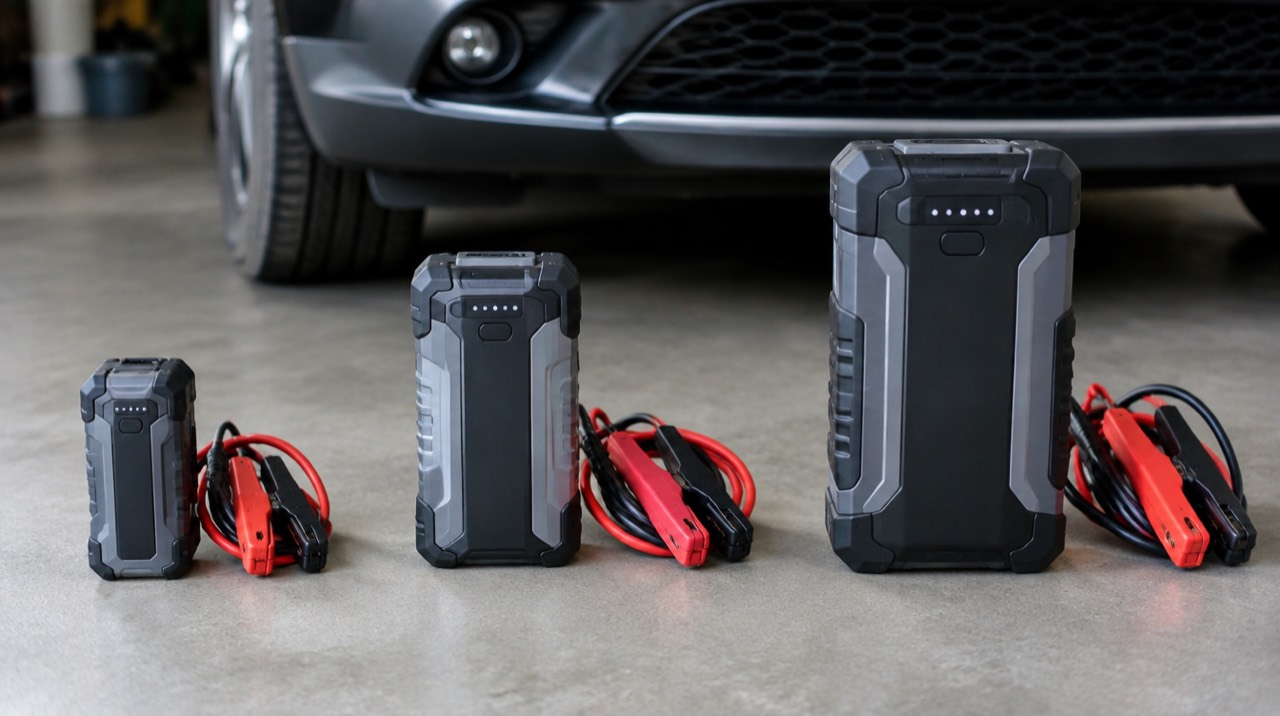
An EV does not need a big pack: the job is waking electronics, not cranking a V8. What matters is that the pack is 12V, compact enough to live in the frunk or under-floor bin, works in your climate, and recharges from USB-C so you can top it up from the car’s own ports. Check the pack’s manual for the battery types it supports.
Featured (disclosed relationship)
ETENWOLF J1 2000A jump starter. A 16,000 mAh 12V pack with a USB-C port, IP65 rating and a listed operating range of -4°F to 140°F, which suits a car parked outside year-round. ETENWOLF says it starts batteries down to 9V and rates it for gas engines up to 8.0L, far more than an EV’s 12V system needs.

Not for: anyone whose EV manual specifies a supply outside a plain 12V pack (Cybertruck owners should read Tesla’s voltage guidance first), or 24V vehicles. The listing does not say whether it is approved for lithium-ion low-voltage batteries; check with the maker if your car has one.
Featured (disclosed relationship)
WOLFBOX MegaVolt16 (MV16). A 3000A, 59.2Wh pack with 65W USB-C in and out, so it doubles as a laptop or phone charger on a road trip and recharges quickly from a USB-C PD charger (not included). WOLFBOX lists IP64 and low- and high-temperature protection, with a 24-month warranty.

Not for: buyers who want the smallest possible pack; it is sized for gas engines up to 8L, more than an EV needs. Same caveat on low-voltage battery chemistry: confirm with the maker.
For a familiar name, the NOCO Boost GB40 is widely sold, but the edition of its user guide we read says it is for 12V lead-acid batteries only, so check that against the battery type your EV uses before buying it for this job. Lithium jump starter safety covers storage, and jump starters in cold weather matters if your EV sleeps outside in winter, because the cold weakens both the car’s 12V battery and the pack.
Why EV 12V batteries go flat
The usual suspects, none of them EV-specific:
- Age. The 12V battery wears out like any other; a car that is a few years old is a candidate.
- Long periods parked with features that keep the car awake (security, monitoring or remote-access features can keep some cars awake; your manual will say which).
- Accessories plugged into the 12V sockets while the car is off.
- Extreme cold or heat, which shortens battery life.
Many EVs show a warning when the low-voltage battery needs service. Take that warning seriously: a weak 12V battery fails without much notice.
Bottom line
- You can jump an EV’s 12V battery, never its drive battery.
- Use the terminals your manual shows; the frunk often needs external power just to open.
- Do not use an EV to jump another car unless the manual says you can; Tesla says you cannot.
- After the jump, keep the car on so it can recharge, then have the 12V battery tested.
- A compact 12V lithium pack with USB-C recharging is the right kit to carry; check the price on Amazon and the battery types its manual lists.
Frequently asked questions
Can you jump-start a Tesla?
You can boost its low-voltage (12V) battery, not the high-voltage drive battery. Tesla's Model 3 manual describes connecting an external 12V supply such as a portable jump starter to the 12V battery under the hood panels, then waking the touchscreen, which can take several minutes. The procedure differs between cars with lead-acid and lithium-ion low-voltage batteries, so follow the manual for your exact car.
Can an electric car jump-start another car?
Tesla says no: its Model 3, Model Y and Cybertruck manuals state the vehicle cannot be used to jump start another vehicle and that doing so can result in damage. Other EV makers vary; unless your owner's manual explicitly allows it, do not use an EV as the donor car.
Why does an electric car have a 12V battery?
The 12V (low-voltage) battery runs door locks, screens, lights and the computers that close the high-voltage contactors. When the car is on, a DC-DC converter charges it from the drive battery, much as an alternator does in a gas car. If it goes flat, the car can be dead even with a full drive battery.
Will a portable jump starter work on an EV?
Usually, if it is a 12V pack and your manual allows an external 12V supply. Tesla, Ford and Hyundai all name a jump box or portable jump starter. Check your pack's battery-chemistry list too: some older pack manuals say they are for 12V lead-acid batteries only, while many EVs now use lithium-ion low-voltage batteries.
What do I do after jump-starting an EV?
Keep the car on so the drive battery can recharge the 12V battery. Hyundai's manual says at least 30 minutes, up to 60 for a fully discharged battery; Ford's support page says drive to a dealer. A 12V battery that goes flat twice should be tested or replaced.
Can I jump-start a dead EV that has no range left?
No. A jump starter only wakes the 12V system. If the high-voltage drive battery is empty, the car needs charging at a charger or a tow; no jump pack can drive it.
Keep planning
- Car Won't Start After a Jump? Battery, Alternator or Starter
Car won't start after a jump start? Use the sound it makes to tell a dead battery from a bad alternator, starter or connection, and know what to check first.
Updated Nov 2026 - Jump Starter Not Working? Fixes for No Power, Lights, Clicks
Jump starter not working? Fix a pack that won't turn on, won't detect the battery, shows a red error light or only clicks, using maker manuals, step by step.
Updated Nov 2026 - What Size Jump Starter Do I Need? Amps by Engine and Climate
What size jump starter do you need? Match the maker's gas or diesel engine rating to your displacement, then size up for cold climates. Tables and examples inside.
Updated Nov 2026