Jump Starter Not Working? Fixes for No Power, Lights, Clicks
In this guide
- Quick diagnosis table
- 1. The pack will not turn on
- 2. The pack is on, but it will not “see” the battery
- 3. A red or flashing error light
- 4. The lights look right, but the engine only clicks or cranks slowly
- 5. It cranks fine but will not start, or dies when unhooked
- Special cases
- When it is time for a new pack
- Bottom line
When a jump starter is not working, the cause is almost always one of five things: the pack itself is low, the clamps are not making clean contact, the pack has locked out because of reverse polarity or heat, the car battery is too flat for the pack to detect, or the pack is the wrong size or voltage for the vehicle. Work through them in that order and most problems clear in a few minutes. This guide is built from maker manuals (mainly NOCO’s GB40 user guide) and listing documentation read on 2026-10-28; your own pack’s manual and light codes take priority.
Disclosure: As an Amazon Associate I earn from qualifying purchases. Some brands featured below pay a bonus commission through Amazon Creator Connections. See /disclosure/. The upgrade section at the end features packs from two of those brands, labelled. The BlueDriver scanner link goes through Levanta, a partner program.
Quick diagnosis table
| What you see | Most likely cause | First fix |
|---|---|---|
| Pack will not turn on at all | Pack battery flat, or in sleep/auto-off | Charge it; press power again |
| Pack on, but “ready” or boost light stays off | Car battery below the pack’s detection voltage, or poor clamp contact | Turn off loads, reseat clamps on bare metal |
| Solid red error light (NOCO) | Clamps reversed | Swap clamps |
| Blinking red error light (NOCO) | Pack’s internal battery too hot | Let it cool, move it to shade |
| Lights fine, engine clicks or cranks slowly | Pack low, too small, cold, or bad contact | Wait 20-30 s, retry; warm the pack |
| Engine cranks well but will not fire | Not a battery problem | Fuel, ignition or security system |
| Starts, then dies as soon as clamps come off | Charging system or a dead battery that cannot hold charge | Have the alternator and battery tested |
1. The pack will not turn on
Charge it first. A pack that has sat in a trunk for a season may be empty even if it was full when you stored it. Most makers ask for a top-up every two to six months, and lithium cells self-discharge faster in heat. How long a jump starter holds a charge has the intervals.
Use a strong enough charger. NOCO’s GB40 guide gives about 3 hours on a 2-amp USB charger, 6 hours on 1 amp and 12 hours on 0.5 amp. A weak phone cube can make a pack look broken. NOCO also recommends not charging and discharging at the same time.
Check the temperature. Lithium cells should not be charged below freezing; GOOLOO, for example, lists a charging range of 14°F to 113°F for its A3. A pack brought in from a frozen car may refuse to charge until it warms up.
Wake it up. Many packs sleep after a few minutes. Press the power button again with the clamps connected.
2. The pack is on, but it will not “see” the battery
This is the most common complaint, and it usually means the car battery is very flat.
How detection works. Smart clamps only energize when the pack senses a battery with the right polarity. NOCO’s GB40 guide says the pack is “designed to jump start 12-volt lead-acid batteries down to 2-volts”; below that, the Boost LED stays off because the pack “can not detect a battery.” NOCO’s newer GBX45 is documented at 3 volts. Packs with a boost button (AstroAI and GOOLOO, for example) describe it as for batteries below about 9 volts, so their thresholds vary widely.
Before any override, do this:
- Turn off the ignition, headlights, HVAC fan and anything plugged in. The GB40 guide’s own fix for a dark Boost light is “remove all loads, and try again.”
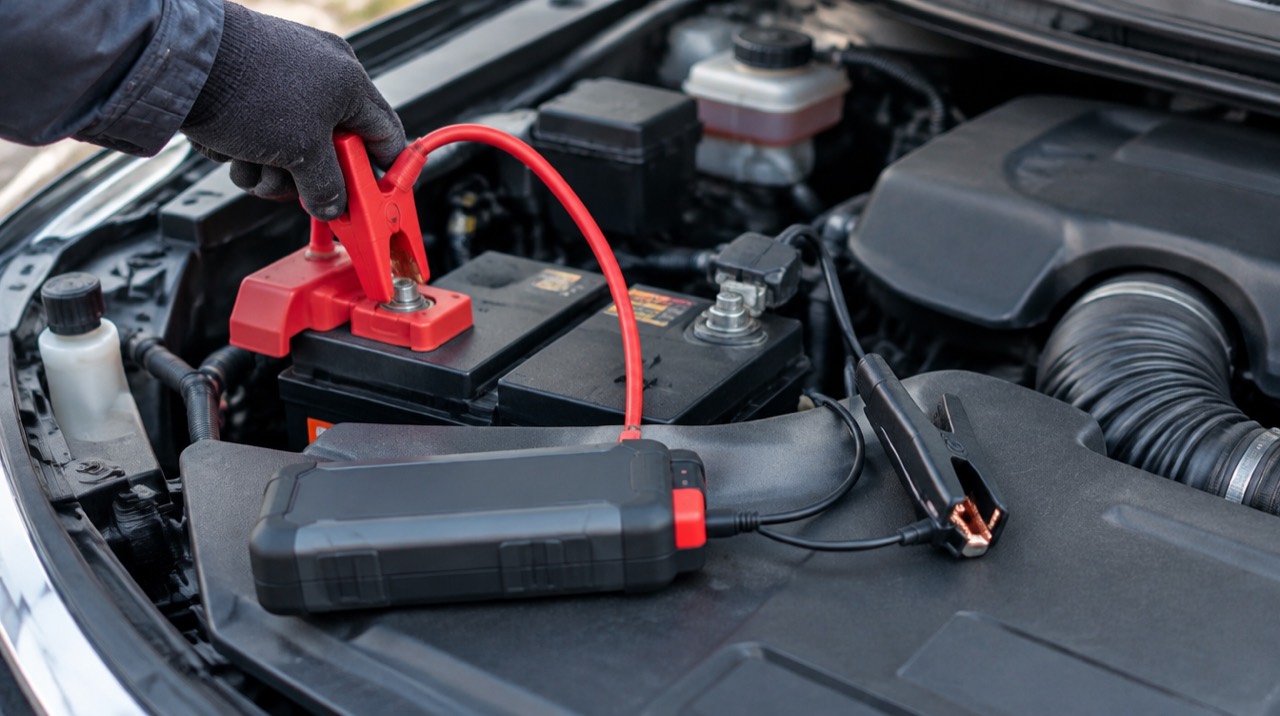
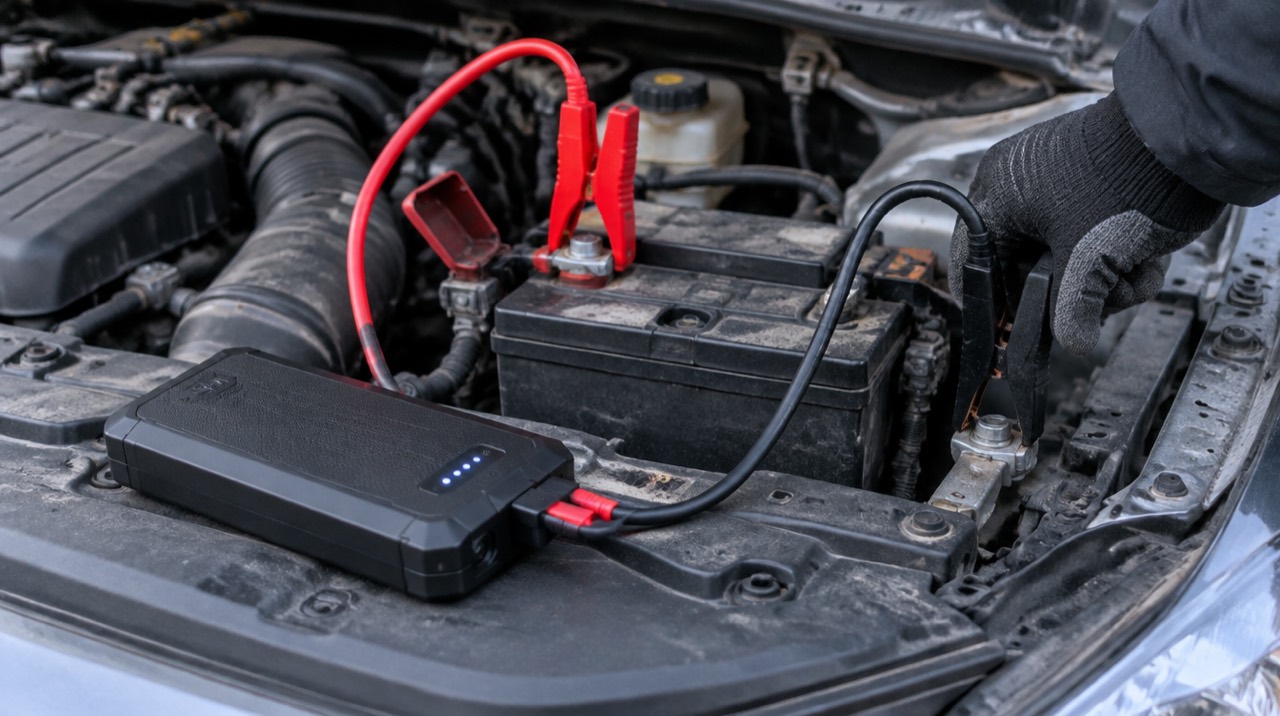
- Unclip and reseat both clamps. The red clamp goes on the bare positive post or remote positive terminal, not on a painted bolt or a plastic cover. The black clamp goes on clean, unpainted metal on the engine or chassis.
- Wiggle each clamp so the teeth bite through corrosion. A white crust on the terminal can block detection.
- Wait a minute with the pack connected, then press power again.
If the car’s battery terminals are hard to reach, use the remote jump points described in where to connect a jump starter.
Manual override and boost mode: read this first. If the battery really is below the threshold, many packs have a way to force the clamps live. On NOCO packs you hold the Manual Override button for three seconds. NOCO’s guidance is blunt about two things. First, the mode disables both spark-proof and reverse-polarity protection, so a reversed clamp or clamps touching each other will spark, at currents up to 1,000 amps on the GB40. Second, according to NOCO’s manual override instructions, “Using Manual Override will not provide any additional power.” It is not a turbo button. The GB40 guide limits the mode to 12-volt lead-acid batteries only.
Use it only when you have confirmed the polarity yourself, the clamps are secured, and nobody is leaning over the battery. If you are unsure, NOCO’s guide says not to attempt it. A battery drained to near zero volts may also be damaged or sulfated beyond what a jump will fix.
3. A red or flashing error light
Light codes differ by brand, so the chart in your manual is the authority. On NOCO’s GB40 user guide:
- Solid red Error LED: reverse polarity. Swap the clamps; the white Boost LED should then come on.
- Blinking red Error LED with clamps connected properly: the internal battery is too hot. Let the pack cool and move it to a cooler place.
- Boost light off with clamps connected properly: battery below 2 volts (see above).
Overheating usually follows several back-to-back attempts or a pack left on a dashboard in the sun. Lithium packs dislike heat as much as cold; lithium jump starter safety covers storage temperatures.
4. The lights look right, but the engine only clicks or cranks slowly
Give it time between tries. NOCO’s guide says some vehicles need the pack connected for up to 30 seconds before starting, and to wait 20 to 30 seconds between attempts. It caps use at five attempts in 15 minutes, then a 15-minute rest. Hammering the key is how packs overheat.
Check the pack’s charge. Many packs will light their indicators at a charge level that is too low to crank a big engine. Charge it to full and retry.
Warm the pack. Lithium output drops in the cold, and a frozen engine with thick oil is harder to crank. Keep the pack in your jacket or the warm cabin for 15 to 30 minutes before trying again. Jump starters in cold weather explains the limits.
Check the size. A pack rated for 4-cylinder engines may not turn over a V8 or a diesel, whatever its peak-amp sticker says. Compare its gas and diesel liter ratings to your engine; what size jump starter do I need has the method.
Check the voltage. Most lithium packs are 12V only. A big truck or piece of equipment with a 24V system needs a 24V-capable unit, and one maker’s listing warns its 12V pack “should not be used on a 24V vehicle.” See best 24V jump starter.
5. It cranks fine but will not start, or dies when unhooked
If the engine spins at normal speed with the pack connected, the jump starter has done its job. A no-start from there points to fuel, ignition, a security immobilizer or a sensor, not the battery. A Bluetooth OBD2 scanner is how you see which of those the car stored. The BlueDriver pairs with a phone and has no subscription. On supported vehicles it reads ABS, SRS and TPMS codes as well as engine codes, per BlueDriver’s product page (read 2026-11-26). It does not test the battery or the alternator. OBD Scanner Guide compares other scanners.
If the car starts and dies the moment you remove the clamps, the vehicle is not producing or holding charge: a failed alternator, a broken belt, a bad cable or a battery with a dead cell. A jump starter cannot fix any of those. Drive straight to a shop or parts store that offers free battery and charging-system tests. Car won’t start after jump start goes through the next checks.
Special cases
Hybrids. The 12V battery in a hybrid is often small and sometimes in the trunk, and some cars have a dedicated under-hood jump terminal. Some Hyundai hybrids use a lithium 12V battery with a “12V BATT RESET” button to press before jumping. See how to jump-start a hybrid car.
Lithium starter batteries. NOCO’s GB40 guide says it is for 12-volt lead-acid batteries only. If your motorcycle, boat or car has a lithium starter battery, follow that battery maker’s instructions; some have their own wake-up procedure.
Start-stop cars with AGM batteries. Connect where the manual says, often to a remote terminal and body ground rather than the battery itself.
When it is time for a new pack
A pack that will not hold a charge for more than a few weeks, swells, gets hot while charging, or smells should be retired and recycled, not repaired. Lithium cells also lose capacity with age. If yours was undersized for your engine to begin with, size up rather than replacing like for like.
Featured (disclosed relationship)
FIVNION W310 6000A jump starter. The listing describes a “Force Start” mode for batteries drained to 0V, rates the pack for all gas engines and diesels up to 10L, and lists a 74Wh battery, a 160 PSI compressor and a -4°F to 140°F operating range. It suits someone whose last pack kept failing to detect deeply drained batteries on a truck or SUV. Like any override, force start bypasses detection, so read its manual first.

Not for: small cars (more pack than you need), buyers who want a published IP rating or a long track record, or 24V systems.
Featured (disclosed relationship)
VACASSO Z08 5000A jump starter. Rated for 10L gas and 8L diesel per the listing, with a 59.2Wh battery, a -4°F to 140°F operating range and a protective case. It fits a reader whose current pack was too small for a V8 or diesel.

Not for: four-cylinder cars, buyers who want force-start or override documented in the listing (the text we read does not describe one), or 24V vehicles.
For a smaller car, a pack like the NOCO Boost GB40 (6.0L gas, 3.0L diesel, IP65) is enough; check the current price on Amazon. The full connection routine is in how to use a jump starter.

Bottom line
Charge the pack, kill every load, reseat the clamps on bare metal and read the lights against your manual. Use override or boost only after you have confirmed polarity, knowing it adds no power and removes the safety net. If the engine cranks but will not run, or dies when unhooked, the problem is the car, not the jump starter.
Frequently asked questions
Why won't my jump starter detect my battery?
Usually the car battery is too flat for the pack's sensing circuit. NOCO's GB40 guide says the pack detects 12-volt lead-acid batteries down to 2 volts; below that the Boost light stays off. Other packs have higher thresholds. Turn off every load, recheck the clamps on clean metal, and only then consider the pack's boost or manual override mode, following its manual.
What does a red light on a jump starter mean?
On NOCO's GB40, a solid red Error LED means reverse polarity (swap the clamps) and a blinking red Error LED means the internal battery is too hot (let it cool). Other brands use different codes, so check the chart in your manual.
Does manual override or boost mode give more power?
No. NOCO says plainly that manual override will not provide any additional power. It only forces the clamps on when the pack cannot sense the battery, and it switches off spark and reverse-polarity protection while it does.
Why does the car just click with the jump starter connected?
A click usually means the starter is not getting enough current. Common causes are a loose or dirty clamp contact, a pack that is low or too small for the engine, a cold pack, or a battery so drained the pack cannot help it. Wait 20 to 30 seconds with the pack connected and try again; if repeated tries fail, the problem may be the starter, a cable or the battery itself.
Can a jump starter work on a 24V truck?
Not a 12V pack. Most lithium jump starters are 12V only, and some listings warn they must not be used on 24V vehicles. Use a pack with a 24V mode.
How many times can I try a jump in a row?
Follow your manual. NOCO's GB40 guide allows up to 30 seconds connected per attempt, 20 to 30 seconds between attempts and no more than five attempts in 15 minutes, then a 15-minute rest.
Keep planning
- Car Won't Start After a Jump? Battery, Alternator or Starter
Car won't start after a jump start? Use the sound it makes to tell a dead battery from a bad alternator, starter or connection, and know what to check first.
Updated Nov 2026 - What Size Jump Starter Do I Need? Amps by Engine and Climate
What size jump starter do you need? Match the maker's gas or diesel engine rating to your displacement, then size up for cold climates. Tables and examples inside.
Updated Nov 2026 - How to Use a Jump Starter: Step-by-Step Instructions
How to use a jump starter or jump box, step by step: clamp order, how long to crank, rest between tries, boost mode and lithium safety, from the manuals.
Updated Nov 2026