Jump Starter vs Jumper Cables: Which Should You Carry?
In this guide
Carry a portable jump starter if you want to fix a dead battery by yourself; carry jumper cables if you want a backup that never needs charging and you can count on finding a second car. For most drivers the pack is the better single item, because the most common dead-battery moment (alone, in a parking lot, at night or in the cold) is exactly when there is no donor car. This comparison draws on vehicle owner’s manuals, the NOCO GB40 user guide and manufacturer listings checked on 2026-10-28; specs are the makers’ own.
Disclosure: As an Amazon Associate I earn from qualifying purchases. Some brands featured below pay a bonus commission through Amazon Creator Connections. See /disclosure/.
The short answer
| Portable jump starter | Jumper cables | |
|---|---|---|
| Needs a second car | No | Yes, running, with a 12V battery |
| Needs charging | Yes, every 2 to 6 months per maker listings | Never |
| Built-in protection | Usually spark-proof and reverse-polarity | None; correct order is on you |
| Works on a frozen battery | No (do not jump a frozen battery) | No |
| Extra uses | USB charging, flashlight, some include a compressor | None |
| Lifespan risk | Lithium cells age, especially in heat | Clamps corrode, insulation cracks |
| Space | Pack plus clamps, roughly a hardcover book | Coil of cable, bulkier in heavy gauge |
| Best for | Solo drivers, commuters, cold climates, night | Backup kit, helping others, no-charge storage |
Both tools do the same job in the end: they push current into the starter circuit for a few seconds so the engine can crank. Neither one recharges a deeply flat battery, and neither fixes a battery that has failed. After any jump, drive long enough for the alternator to put charge back, then get the battery tested.
Jumper cables: how they work and where they fall short
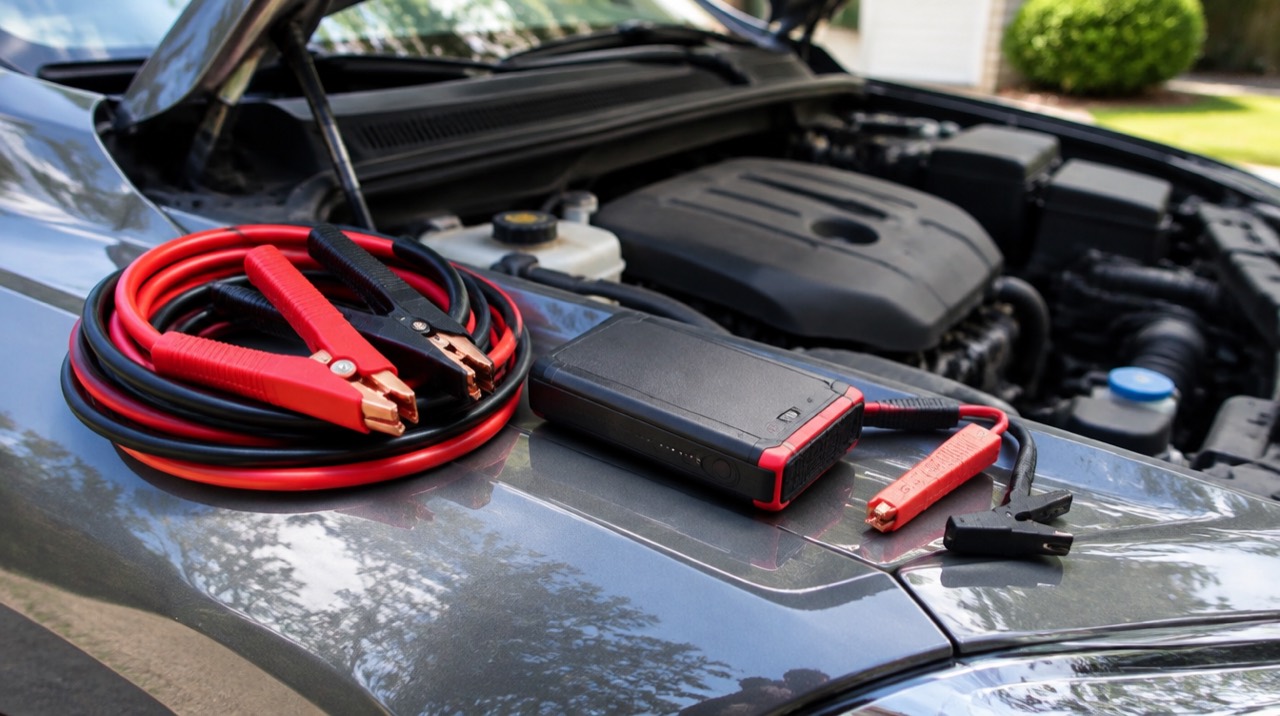
Jumper cables connect your dead battery to a healthy battery in another vehicle. The donor car’s battery and alternator do the work. That makes cables cheap, simple and durable, and it is why they still have a place in a winter kit.
The catch is the second car. It must be running, it must have a 12V system, and it must be able to park close enough. Mazda’s owner’s manual, for example, says to use only a 12V booster and warns that a 24V source, such as two 12V batteries in series, can permanently damage the starter, ignition and other electrical parts (Mazda owner’s manual, jump-starting). Most big diesel pickups are still 12V, but some heavy trucks and equipment are 24V, so ask before you connect.
Cable gauge and length
The gauge number is backwards from what most people expect: a lower American Wire Gauge (AWG) number is a thicker conductor. Every three steps down doubles the copper cross-section, and aluminum conducts only about 61 percent as well as copper, so a copper-clad aluminum cable behaves like copper roughly two sizes thinner (American wire gauge). That matters, because cheap cables often print a heavy gauge on a light conductor.
There is no federal or SAE rule tying cable gauge to engine size. Retail guidance converges on roughly these choices, which are sensible starting points rather than standards:
| Vehicle | Commonly recommended gauge | Typical length |
|---|---|---|
| Compact and mid-size cars | 6 gauge | 12 to 16 ft |
| SUVs, minivans, half-ton pickups | 4 gauge | 16 to 20 ft |
| Large V8 and diesel trucks | 2 or 1 gauge | 20 to 25 ft |
| 10 or 8 gauge “emergency” sets | Weak batteries in mild weather only | Short |
Longer cables add resistance, so if you buy 25 feet for a trunk-mounted battery, step up a gauge to compensate. Look for full copper conductors, clamps with copper jaws and insulation that stays flexible in the cold.
The hookup order that matters
Owner’s manuals agree on the order because one step can ignite hydrogen gas from the battery. Mazda’s version:
- Turn off both engines and all unnecessary loads. Keep the vehicles from touching.
- Red clamp to the positive post of the dead battery.
- Other red clamp to the positive post of the donor battery.
- Black clamp to the negative post of the donor battery.
- Last black clamp to a bare metal ground point away from the dead battery, not to its negative post. A spark there could ignite battery gas.
- Route cables clear of fans and belts. Start the donor car and let it run a few minutes, then start the dead car.
- Remove the clamps in reverse order.
Never jump a battery that is frozen or low on fluid; Mazda warns it may rupture or explode. Check your own manual too, because some cars specify remote jump terminals under the hood rather than the battery posts (where to connect a jump starter).
Portable jump starters: what you gain and what you take on
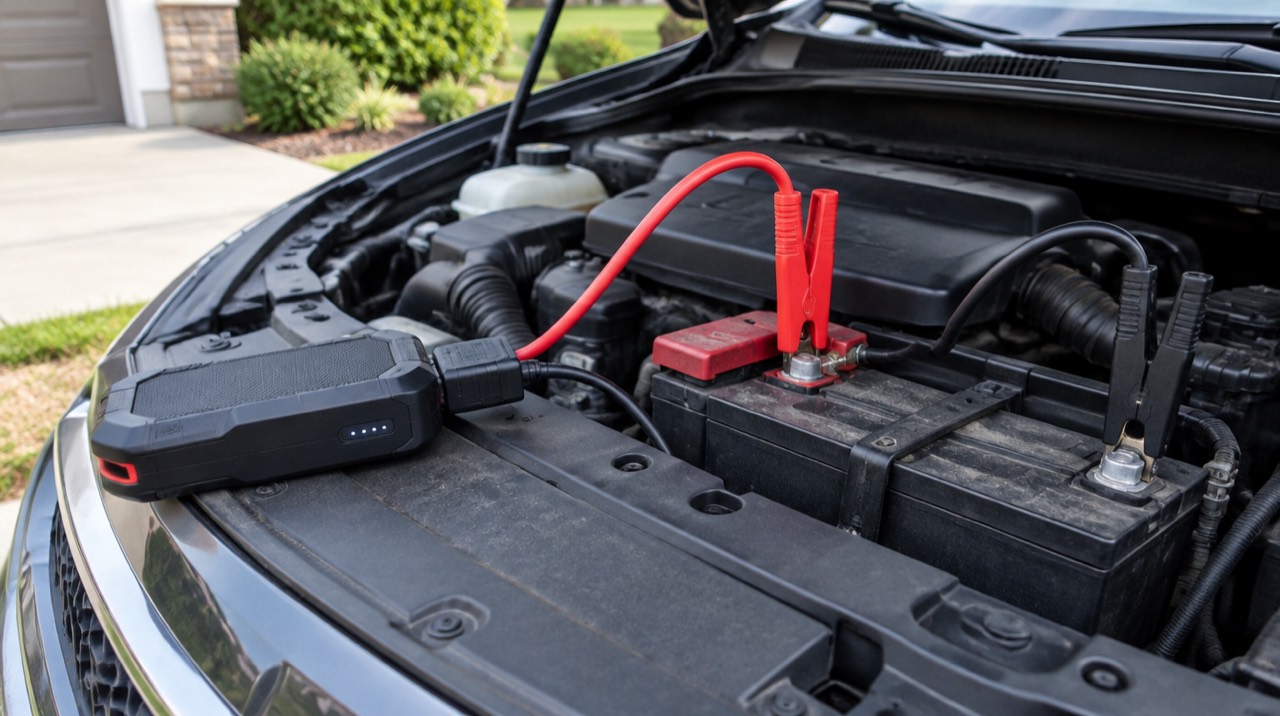
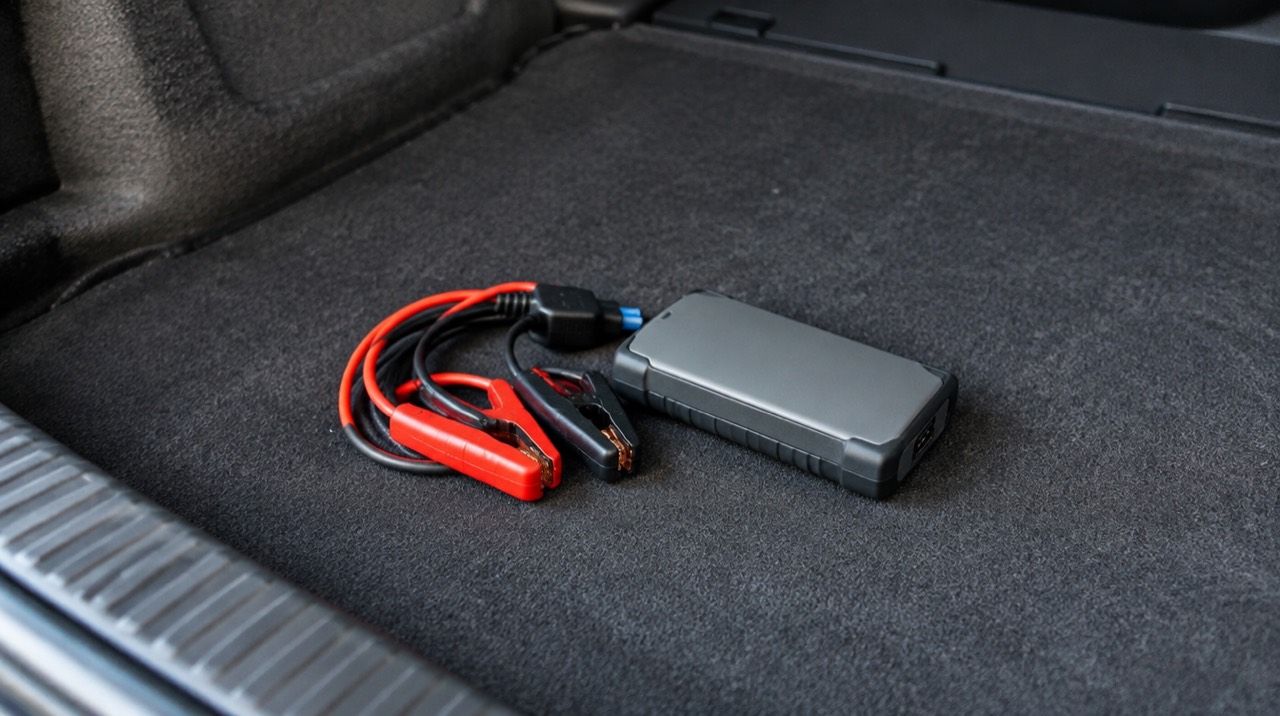
A jump starter is a lithium battery pack with short clamps and a protection circuit. You connect it to your own battery, switch it on, crank, and disconnect. No second car, no long cables to route around a parked vehicle, and most packs refuse to send current if the clamps are reversed. The full sequence is in how to use a jump starter.
What you take on is maintenance. A pack is only useful if it is charged:
- Recharge on schedule. Listings we read ask for a top-up every 2 to 3 months (GOOLOO GP4000, Giroago) or every 3 months (HDJFLU, Odifni). How long a jump starter holds a charge explains why heat and time drain them.
- Respect the temperature range. Most packs list storage and operating ranges, often -4°F to 140°F. A dashboard in July can exceed that; see lithium jump starter safety.
- Do not crank endlessly. NOCO’s GB40 guide limits cranking to 30 seconds with 20 to 30 seconds between attempts and a 15-minute rest after five tries.
- Know what override does. NOCO’s GB40 guide says its Manual Override turns off the spark-proof and reverse-polarity protection. Many brands’ boost or force-start buttons work similarly. Use them only as the manual describes.
Packs are rated by engine size rather than by a standard amp figure, which is why the peak amps vs cranking amps number on the box is less useful than the gas and diesel liters the maker lists. What size jump starter do I need turns those ratings into a choice.
Which one for which driver
- You commute alone, park in garages or drive at night: jump starter. The whole point is not needing anyone.
- You live somewhere very cold: jump starter rated well above your engine size, kept in the cabin overnight in the worst weeks, plus cables as backup. See jump starters in cold weather.
- The car sits for months between drives: cables, or a pack you commit to recharging. A forgotten pack is dead weight.
- You drive a big diesel pickup: a pack rated for diesel well above your displacement, or 2-gauge cables with a willing donor; best jump starter for a diesel truck covers sizing.
- You want to help other drivers: cables. A pack can start other cars too, but cables let a donor car do repeated work without draining anything of yours.
- You want one kit that covers everything: both. Cables weigh little and never fail to hold a charge.
Packs that suit a “replace the cables” buyer
If you are moving from cables to a pack, the safest bet is one rated comfortably above your engine with a published operating range and a recharge interval you can live with. These are examples on published specs, not a full ranking; the best portable jump starter roundup compares more.
Featured (disclosed relationship)
ETENWOLF J1 2000A jump starter. The listing rates it for 8.0L gas and 6.5L diesel engines, up to 35 starts per charge, a stated operating range of -4°F to 140°F, starts on batteries down to 9V, a 2-hour recharge and an IP65 shell. For most cars and SUVs that is generous headroom in a pack small enough for a door pocket.

Not for: 24V trucks, or large diesels much above the 6.5L rating in a cold climate.
Featured (disclosed relationship)
VACASSO Z08 5000A jump starter. Rated for 10L gas and 8L diesel, a 59.2Wh battery, a 500-lumen light, a stated -4°F to 140°F operating range and a hard case. It is the more natural replacement for heavy cables on a pickup. The listing gives two recharge intervals (every 3 to 6 months and every 2 to 3 months); follow the shorter.

Not for: drivers who want the smallest pack, or anyone who will not keep up with recharging.
Featured (disclosed relationship)
WOLFBOX MV16 3000A jump starter. The title and bullets rate it for 8L gas and 6L diesel (the description says gas engines under 10L; plan on the lower figure), with 65W USB-C charging in and out, an IP64 rating and a 24-month warranty. A good fit if you also want the pack to charge a laptop or phone.

Not for: diesel trucks near or above 6L, or buyers who want a charger in the box (the listing says it is not included).
Non-campaign alternatives worth comparing are the NOCO Boost and GOOLOO lines; NOCO vs GOOLOO lays them side by side. Check the current price on Amazon for any of these.
Cost over time
Cables are a one-time buy that lasts until the clamps corrode or the insulation cracks. A pack costs more up front and its lithium cells age, faster in heat, so plan on replacing it eventually; makers do not publish a lifespan in years, and we found no independent figure. On the other hand, a single avoided roadside call or tow can cover much of the difference, and the pack doubles as a USB power bank and flashlight.
Mistakes to avoid with either tool
- Clamping the last negative to the dead battery’s post. Use a ground point away from the battery.
- Using thin “bargain” cables on a big engine. They heat up and may not pass enough current to crank.
- Leaving a pack flat for a year. Deeply discharged lithium packs may refuse to charge again.
- Jumping a frozen or swollen battery. Replace it instead.
- Driving off and forgetting the battery. A jump is a rescue, not a repair. If it happens twice, test the battery and charging system; car won’t start after a jump start covers the next checks.
Bottom line
A charged jump starter is the better single tool for most drivers because it removes the need for a second car. Jumper cables remain the cheapest, longest-lived backup and the better way to help someone else. If space allows, keep a pack sized above your engine in the cabin and a set of 4- or 6-gauge copper cables in the trunk, and set a calendar reminder to recharge the pack.
Frequently asked questions
Is a jump starter better than jumper cables?
For most drivers, yes, because it does not need a second car. A charged lithium pack lets you start a car alone in a parking garage, on a rural road or at night. Jumper cables are cheaper, never need charging and last for years, but they only work when another running vehicle with a 12V battery can park close enough.
What gauge jumper cables do I need?
Lower gauge numbers mean thicker copper. Retail guidance commonly points to 6 gauge for cars and 4 gauge for SUVs and light trucks, with 2 or 1 gauge for big V8 and diesel engines. Check that the cables are solid copper rather than copper-clad aluminum, which carries less current for the same printed gauge.
Can jumper cables and a jump starter damage my car?
Either can if misused. Connecting a 24V source to a 12V car can damage the starter and electronics, and connecting the last clamp directly to the dead battery's negative post can ignite battery gas. Lithium packs add reverse-polarity and spark protection, but manual override or boost modes turn some of that off.
Should I keep both in the car?
If you have room, yes. A pack is the faster solo fix; cables are the backup that never runs flat and can help another driver whose battery is worse than yours. If you only carry one, carry the pack and set a recharge reminder every two to three months.
How long should jumper cables be?
Long enough to reach battery to battery when the cars cannot park nose to nose. Retail advice ranges from about 12 feet for cars to 20 feet or more for trucks and trunk-mounted batteries. Longer cables lose a little more voltage, so pair extra length with a thicker gauge.
Keep planning
- Best Black Friday Jump Starter Deals 2026: Timing and What to Buy
The best jump starter Black Friday deals in 2026, with guidance on which specs matter, which brands discount and how to avoid buying undersized packs.
Updated Nov 2026 - Best Portable Jump Starter for Cars, Trucks and Diesels (Spec Picks)
The best portable jump starter for your engine and fuel: spec-based picks from NOCO, GOOLOO, ETENWOLF and VACASSO, sized for cars, V8 trucks, diesels and winter.
Updated Nov 2026 - Cordless vs 12V Tire Inflator: Speed, Duty Cycle, Convenience
Cordless vs 12V tire inflator compared on published specs: airflow, duty cycle, tires per charge and truck-tire limits, so you can pick the right type.
Updated Oct 2026